Skip to content
Start My 3 Free Days $0 today · cancel anytime

Sound Resources

5 sound resources: 5 worksheets. How teachers use these

Sound Resources

5 sound resources: 5 worksheets. How teachers use these

Worksheet
Worksheet4th GradeWhat Made That Sound? Worksheet

The What Made That Sound Worksheet asks 4th graders to read four one-second sound waves and decide whether each note is loud or soft, high or low. Answer key included for fast, confident checking.

Worksheet
Worksheet3rd GradeSound Pitch Worksheet

This Sound Pitch Worksheet helps 3rd grade students use sound waves and real instruments to tell whether a vibration makes a high or low pitch. An answer key is included, so science practice takes minutes to set up.

Worksheet
Worksheet1st GradeSound Volume Worksheet

This sound volume worksheet asks first grade students to circle the loudest sound in each row, then color circles that grow louder. An answer key is included, so children learn to compare loud and soft sounds.

Worksheet
WorksheetKindergartenCan You Hear It? Worksheet

The Can You Hear It? Worksheet asks kindergarten students to circle loud sounds and cross out soft sounds across nine picture cards, with an answer key for quick, easy checking.

Worksheet
Worksheet4th GradeLet's Make Some Noise Worksheet

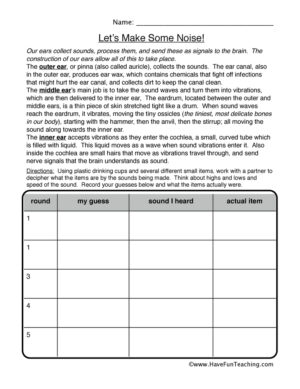
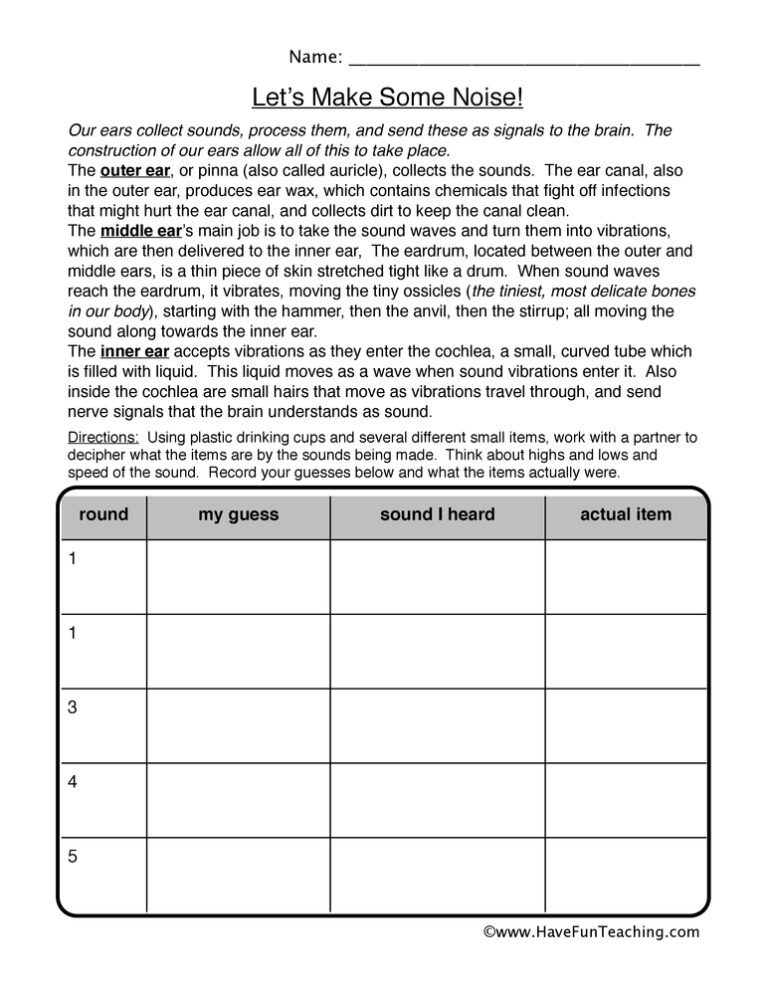
The Let's Make Some Noise Worksheet helps 4th grade students read about how sound travels and how the ear hears, then answer questions. An answer key is included for quick checking.

From our teachers' playbook

Buzz, boom, whisper and roar!

What do kids learn about sound?

Sound is made when something vibrates, or moves back and forth very fast. Kids learn that vibrations travel through air, water and solids to reach our ears. They explore volume (how loud or soft) and pitch (how high or low), and they discover that a tight, short rubber band makes a higher sound than a loose, long one. Older students learn that sound travels as waves and moves faster through solids than air. The click comes when kids put a hand on their throat, hum, and feel the vibration making their voice.

How we teach sound

Sound is one of the most hands-on topics in science. Here is how we make it ring.

Feel the vibration

Stretch rubber bands over an open box and let kids pluck them. Then sprinkle rice on a drum or a plastic-wrapped bowl and tap it. Seeing the rice jump shows that sound really is movement.

Why it works: going from real objects to pictures to symbols is a core recommendation of the U.S. Department of Education's elementary math guide.

Let's Make Some Noise WorksheetTry it withLet's Make Some Noise WorksheetWorksheetsOpen it →

High or low?

Show pictures of a bird, a lion, a whistle and a tuba, and have kids sort them into high and low pitch. Then play real recordings to check. Sorting gives kids the words before the science gets deeper.

Why it works: children learn more from words and pictures together than from words alone (Mayer, 2009).

Sound Pitch WorksheetTry it withSound Pitch WorksheetWorksheetsOpen it →

Loud or soft check

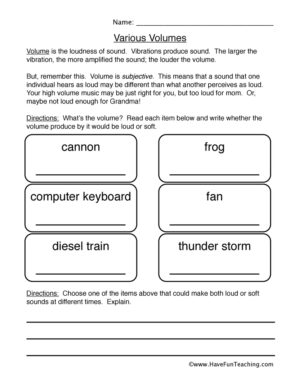
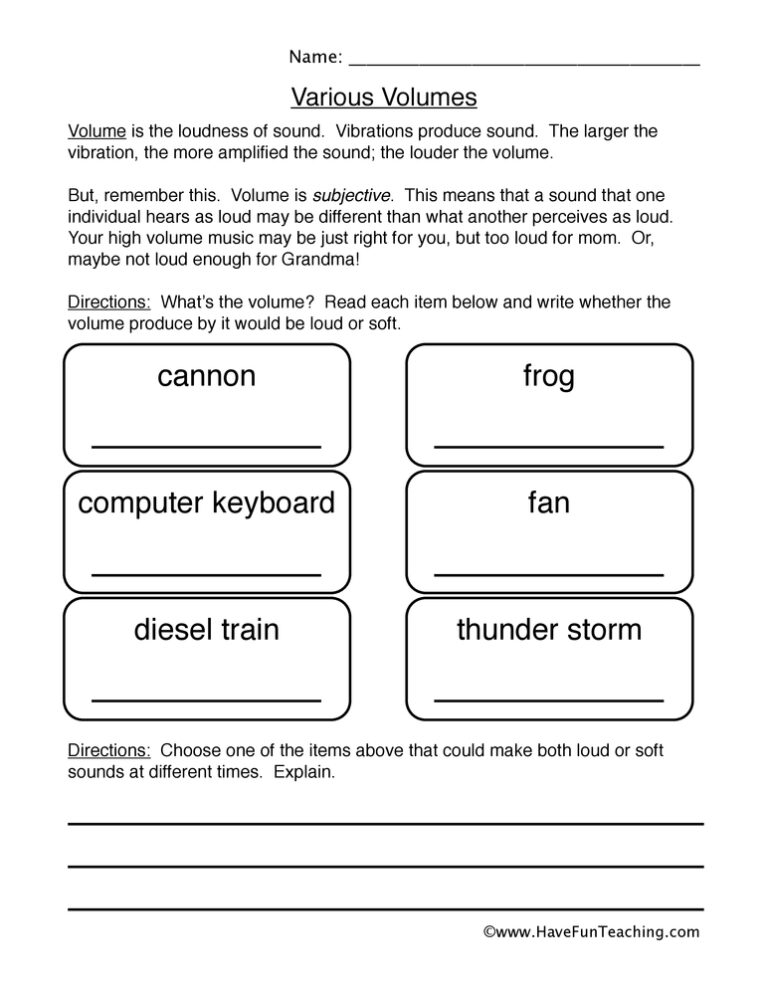
Give kids a short page sorting everyday sounds by volume, then talk about which sounds are safe and which could hurt our ears. A quick check plus a real-life connection makes volume meaningful.

Why it works: researchers who compared ten study methods found practice testing is one of the two that work best (Dunlosky and colleagues, 2013).

Sound Volume WorksheetTry it withSound Volume WorksheetWorksheetsOpen it →

Questions parents and teachers ask

How is sound made for kids?

Sound is made when something vibrates, which means it moves back and forth very quickly. The vibrations travel through the air to our ears, and our brain hears them as sound.

What is the difference between pitch and volume?

Pitch is how high or low a sound is, like a whistle versus a tuba. Volume is how loud or soft a sound is. A sound can be high and soft or low and loud.

What grade learns about sound?

Many 1st graders study sound and vibration, and 4th graders often return to it as part of waves and energy. The ideas grow deeper each time.

What is an easy sound experiment at home?

Make a cup phone with two paper cups and a string pulled tight. Kids can hear each other because the vibrations travel along the string.

Keep exploring