Skip to content
Start My 3 Free Days $0 today · cancel anytime

2nd Grade Compound Words Resources

12 2nd grade compound words resources: 8 worksheets, 3 activities and 1 lesson plan. How teachers use these

2nd Grade Compound Words Resources

12 2nd grade compound words resources: 8 worksheets, 3 activities and 1 lesson plan. How teachers use these

Worksheet
Worksheet2nd GradeCompound Word List

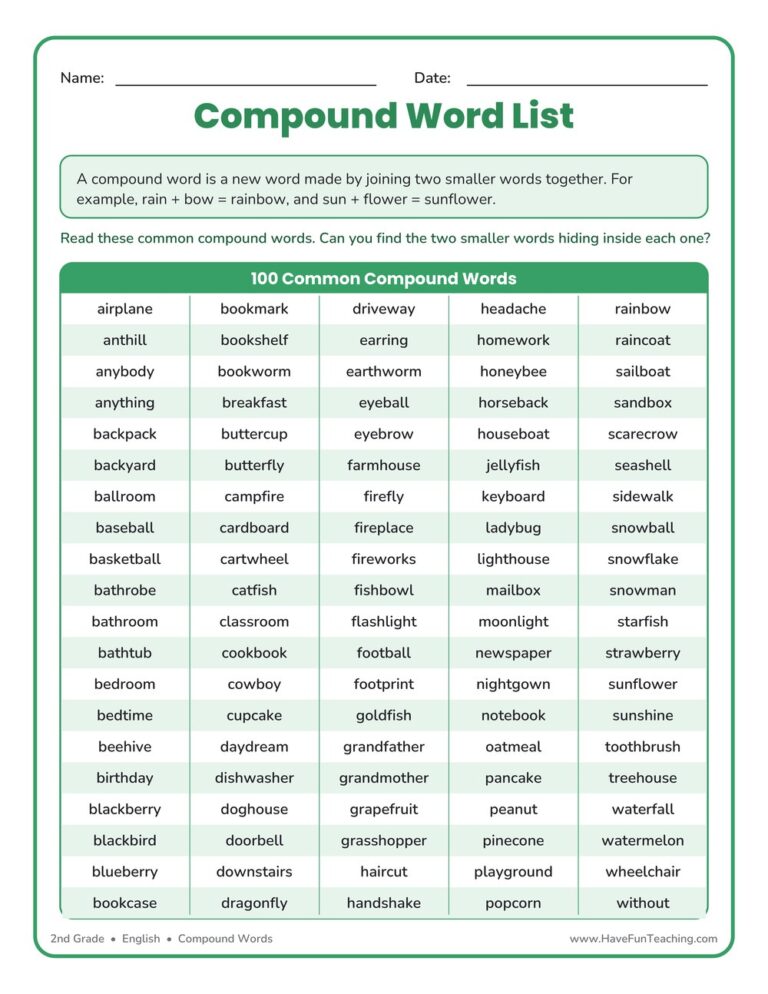
This compound word list worksheet gives 2nd graders a handy reference of 100 common compound words to read, spell, and explore. A clean, printable chart that is perfect for word walls, folders, and no-prep vocabulary practice.

Worksheet
Worksheet2nd GradeCompound Words Fill in Blank Worksheet

This Compound Words Fill in Blank Worksheet asks 2nd graders to complete six sentences with the right compound word from the word bank. An answer key is included, so practice takes minutes and needs no prep.

Worksheet
Worksheet2nd GradeCompound Words Worksheet

This compound words worksheet gives 2nd graders two ways to practice: breaking words like sunflower into their two parts, then joining word pairs to build brand-new words. An answer key is included, so checking takes seconds.

Worksheet
Worksheet2nd GradeCreate Compound Words Worksheet

This Create Compound Words Worksheet has 2nd graders match word parts to build rainbow, butterfly, and snowman, then split sunflower, backpack, and doghouse into two small words. Answer key included for fast, no-prep vocabulary practice.

Activity
Activity2nd GradeCompound Words Activity

A compound words activity where 1st to 3rd grade children match picture cards to word cards and build new words from two small ones. Answer key included for easy checking.

Worksheet
Worksheet2nd GradeSyllables Compound Words Worksheet

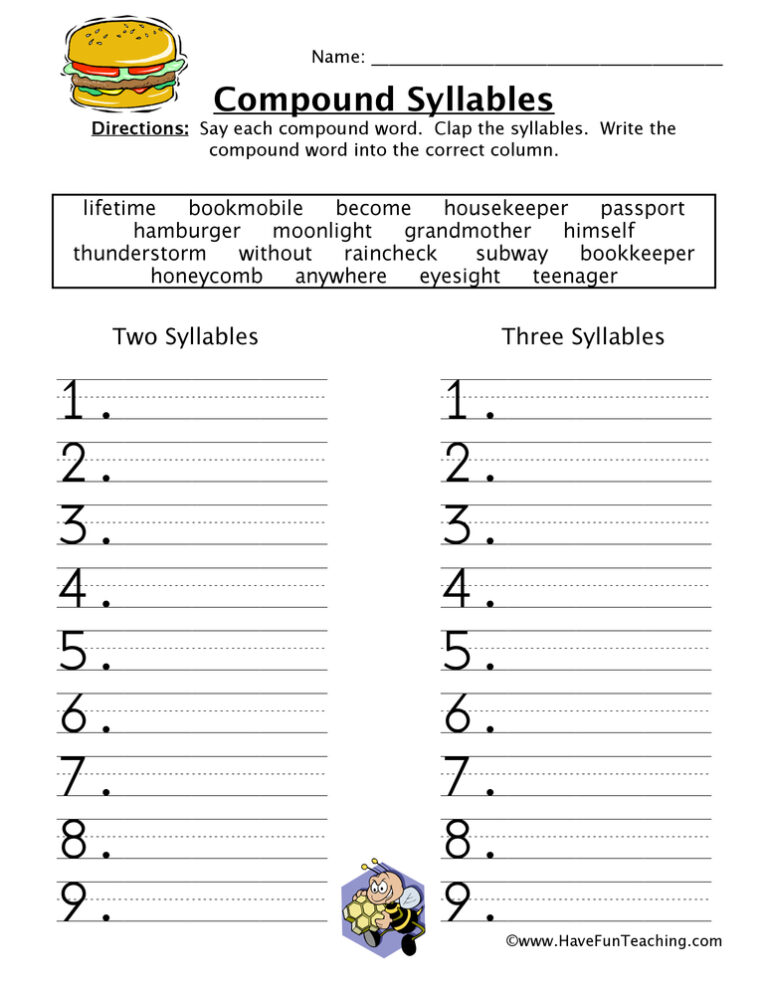
This syllables compound words worksheet has 2nd Grade students clap and sort compound words by syllables, then split new compound words into two smaller words. An answer key is included.

Worksheet
Worksheet2nd GradeCount the Compound Words Syllables Worksheet

In this Count the Compound Words Syllables Worksheet, 2nd grade students split compound words into their two parts, clap the syllables, and circle compound words in sentences. Answer key included.

Worksheet
Worksheet2nd GradeCompound Words Cutting Worksheet

This compound words cutting worksheet has 2nd graders cut out word cards, glue them to finish four compound words, and write each new word. A full answer key is included for quick checking.

Worksheet
Worksheet2nd GradeCompound Words Equations Worksheet

The Compound Words Equations Worksheet gives 2nd Grade students six word equations to solve and three sentences to finish. An answer key is included, so practice is quick to assign and quick to check.

Lesson Plan
Lesson Plan2nd GradeCompound Words Lesson Plan

Materials available in this Compound Words Lesson Plan include Compound Word Activities, Compound Word Worksheets, and a Compound Word Flash Card Set.

Activity
Activity2nd GradeSanta's Compound Cookies Activity

Using Santa's Compound Cookies Activity, studentsput together his cookies to form compound words to figure out what Santa wants for Christmas.

Activity
Activity2nd GradeSt. Patrick's Day Compound Words Activity

Using St Patrick's Day Compound Words Activity, students match pictures cards to compound word cards to build their reading fluency.

From our teachers' playbook

Two little words make one big one

What do 2nd graders learn about compound words?

Second graders learn that a compound word is two smaller words joined together to make a new word: sun + flower = sunflower, rain + bow = rainbow. They use the two parts to predict the meaning (a doghouse is a house for a dog), which is a great vocabulary strategy. Splitting compound words also helps with reading and spelling long words. The click moment is when a child sees "butterfly" and laughs, "A fly made of butter? That's silly!" and starts noticing compound words everywhere.

Our favorite ways to teach compound words

Compound words are pure fun to take apart. These moves make the most of it.

Split and predict

Write "toothbrush" and draw a line between the two words. Think aloud: "Tooth and brush. So it's a brush for your teeth!" Model three more, then let kids try. Predicting meaning from parts is the real skill.

Why it works: handing over the work step by step, from teacher to student, is one of the most widely used teaching frameworks (Pearson and Gallagher, 1983).

Compound Words Lesson PlanTry it withCompound Words Lesson PlanLesson PlansOpen it →

Cut and glue new words

Kids cut out word cards and glue pairs together to make compound words, then draw a picture of each. The scissors make the two parts obvious, and the pictures show the meaning.

Why it works: going from real objects to pictures to symbols is a core recommendation of the U.S. Department of Education's elementary math guide.

Compound Words Cutting WorksheetTry it withCompound Words Cutting WorksheetWorksheetsOpen it →

Fill the missing half

Give sentences with half a compound word missing: "I wore my rain___ in the storm." Kids pick the right word to finish it. Quick and contextual, it shows who understands meaning, not just matching.

Why it works: researchers who compared ten study methods found practice testing is one of the two that work best (Dunlosky and colleagues, 2013).

Compound Words Fill in Blank WorksheetTry it withCompound Words Fill in Blank WorksheetWorksheetsOpen it →

Compound word questions parents and teachers ask

What is a compound word?

A compound word is made by joining two smaller words, like snow + man = snowman. The new word usually has a meaning connected to both parts.

What are examples of compound words for 2nd grade?

Good examples include sunflower, rainbow, cupcake, football, backpack, bedroom, toothbrush, sandbox and butterfly. Kids enjoy finding them in books.

Why are compound words important?

They help kids read and spell longer words by breaking them into parts. They also teach a vocabulary strategy: using word parts to figure out meaning.

How can I practice compound words at home?

Go on a compound word hunt at home: bedroom, doorbell, toothpaste. Write the two words on cards and let your child put them together and explain the meaning.