
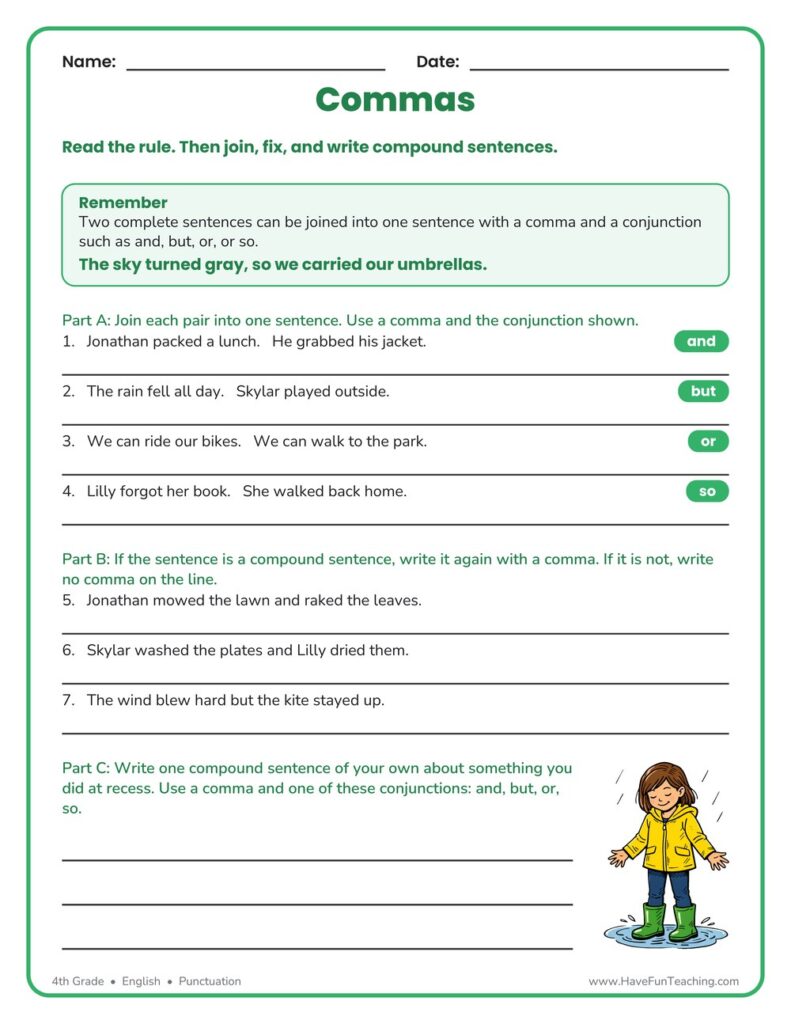
Independent Clauses Comma Worksheet
This independent clauses comma worksheet gives 4th graders eight chances to join, fix, and write compound sentences with a comma. Answer key included, so students can check their own punctuation and write with confidence.
$6.97
Or free with a membership — members pay $3.33/mo for all 10,000+ resources. See plans
Want this one free?
Tell us where to send it and it’s yours — no card, no catch.
One free resource per teacher. We’ll also send free teaching ideas each week — unsubscribe anytime.
Teaching is easier with a membership
Unlimited printables, games & videos for PreK–6th — for your classroom or homeschool. Cancel anytime.
Start your 3-day free trial$0 today · cancel anytime · Instant access to 10,000+ resources
About this resource
Description
An independent clause is a group of words that could stand alone as a complete sentence, and when two of them are joined into one longer sentence, a comma has to do that joining together with a conjunction. This Independent Clauses Comma Worksheet gives fourth graders focused practice with that exact rule: the comma comes first, and then the conjunction — and, but, or, or so. Knowing where the comma belongs helps students write longer, smoother sentences instead of running two separate thoughts together.
This compound sentence comma worksheet opens with a short rule box and a model sentence, so students can check the pattern before they begin. In Part A they join four pairs of sentences using the conjunction shown beside each item. In Part B they decide whether a sentence is truly compound or simply has two verbs sharing one subject, then rewrite it with a comma or write no comma on the line. Part C asks them to compose a compound sentence of their own. Use it as guided practice, morning work, a grammar center, or a quick review before a writing assessment.
What’s Included
- 1 print-ready PDF worksheet
- Answer key
- 8 comma and compound sentence activities
There are three reasons this Independent Clauses Comma Worksheet builds real skill. First, it separates the rule from its look-alike: students see that the comma belongs before the conjunction only when both halves could stand alone as sentences. Second, every item asks for writing rather than circling, so the punctuation mark is practiced in the place it will actually be used. Third, the last item moves from copying to composing, which is where grammar practice turns into stronger writing.
Teachers and parents can keep the practice going in small ways. Read a favorite chapter book aloud and hunt for compound sentences, then talk about what each half would sound like on its own. Write two short sentences on index cards and let students choose the conjunction that connects them best. During writing conferences, ask students to find two short sentences in their own draft and combine them into one. A five-minute sentence-combining warm-up a few times a week is often all it takes.
Related Resources
What teachers say
Reviews
You must be logged in to post a review.

This Quotations Punctuation Worksheet asks 4th graders to tell direct speech from retold speech, then rewrite five sentences with quotation marks in place. Answer key included for fast, no-prep grammar practice.

This writing with commas worksheet helps 4th graders add commas to lists and compound sentences, sort how each comma is used and write their own sentence. An answer key is included for easy checking.

Using Including Punctuation Worksheet, students finish sentences using the correct end punctuation for the sentence type.

Using Quotation Marks Practice Worksheet, students write quotation marks correctly where they belong in each sentence so they can set off a quote or dialogue in their own writing.

Using Creating End Punctuation Worksheet, students write their own sentence types using the correct end punctuation.

Using Quotation Marks Punctuation Worksheet, students write quotation marks correctly where they belong in each sentence so they can set off a quote or dialogue in their own writing.
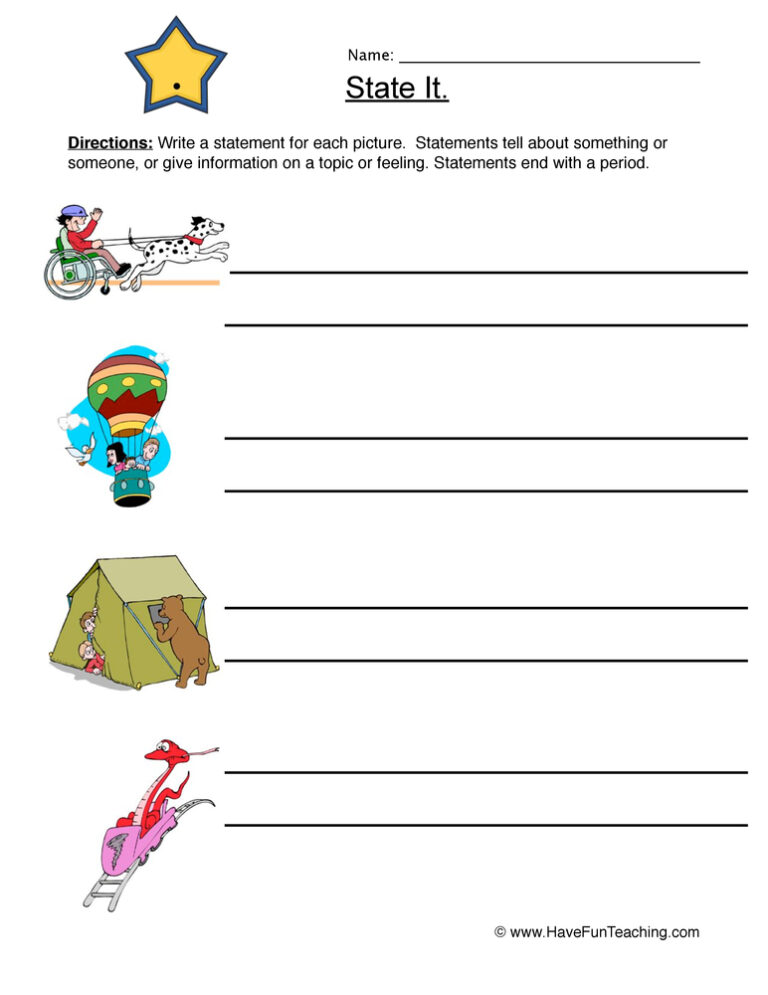
Using Statements Worksheet, students write a statement describing each picture.

Using Writing With End Punctuation Worksheet, students write a passage on any topic using correct end punctuation multiple times.

Using Including End Punctuation Worksheet, students finish sentences using the correct end punctuation for the sentence type to improve writing skills.

Using L.4.2 Fourth Grade Common Core Lesson, students correctly use quotation marks in their writing to share their character's thoughts and feelings effectively.

Using this Proofreading Capitalization and Punctuation Activity, students make punctuation and capitalization corrections on the laminated activity cards.

Using this Commas Types Worksheet, students write their own sentences that highlight the different types of comma usages.




Reviews
There are no reviews yet