
Skip to content
Start My 3 Free Days $0 today · cancel anytime

5th Grade Matter Resources

11 5th grade matter resources: 8 worksheets, 2 songs, 1 video and more. How teachers use these

5th Grade Matter Resources

11 5th grade matter resources: 8 worksheets, 2 songs, 1 video and more. How teachers use these

Worksheet
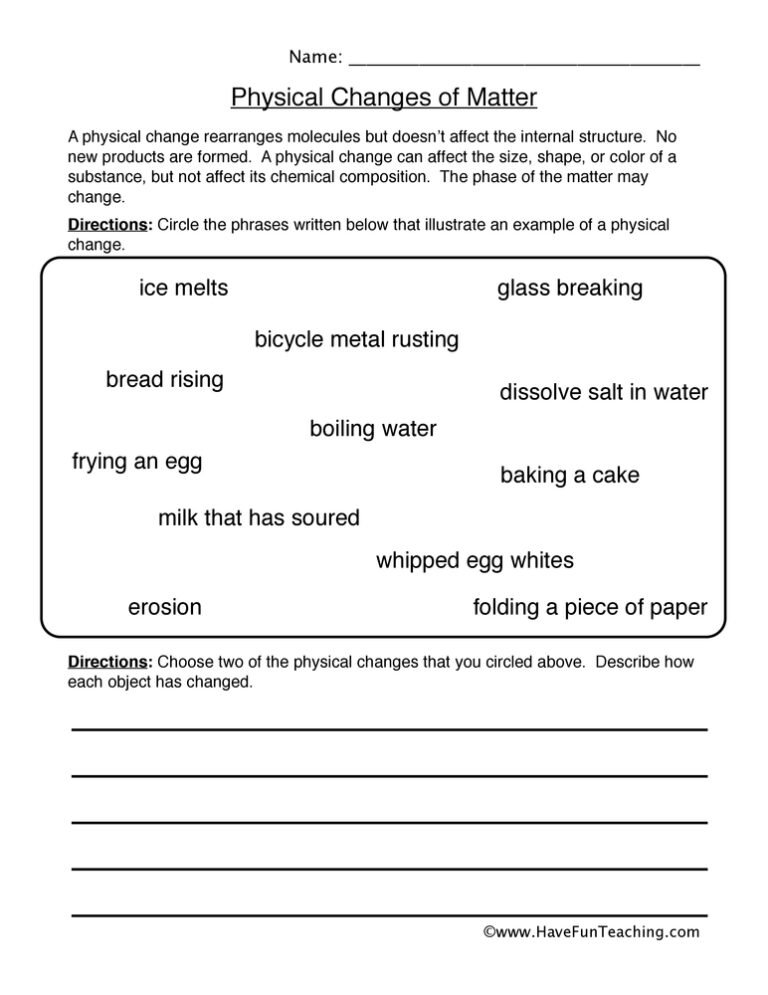
Worksheet5th GradePhysical Changes Matter Worksheet

This physical changes matter worksheet asks 5th Grade students to sort eight everyday changes, label three states of matter, and explain their thinking, with an answer key included for fast grading.

Video
Video5th GradeMatter Song

The Matter Song teaches all about matter and the states of matter. With this states of matter song, students learn about solid, liquid, and gas, as well as the phases of matter, properties of matter, physical changes, chemical changes, and so much more. Matter has mass and takes up space.…

Worksheet
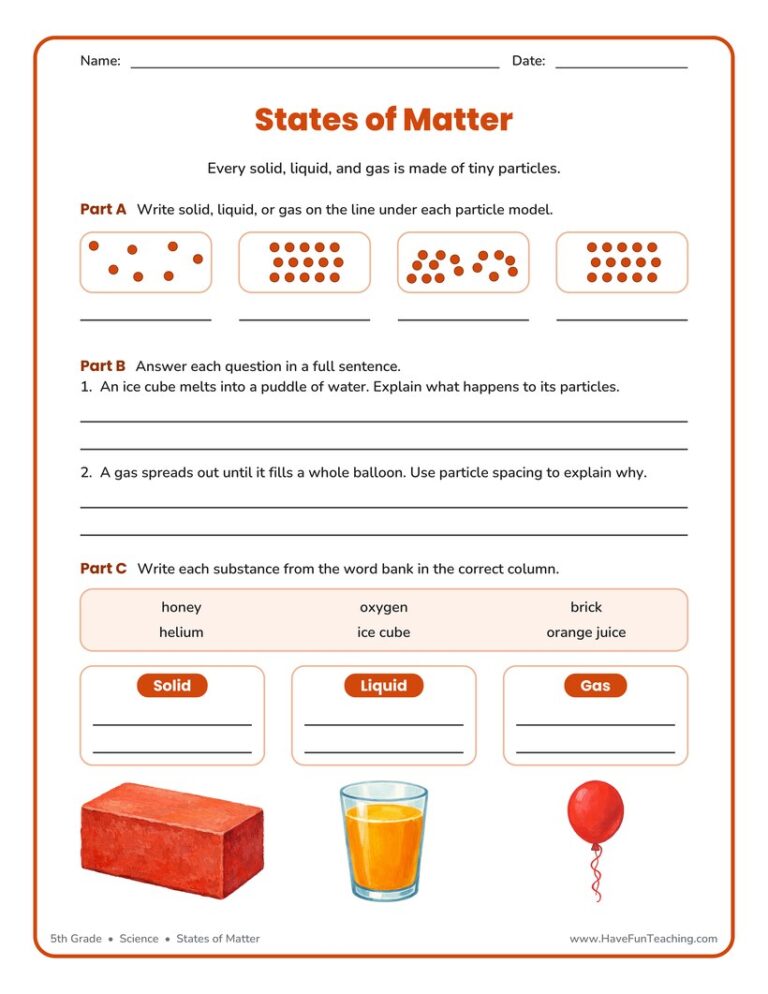
Worksheet5th GradeIdentifying States of Matter Worksheet

This Identifying States of Matter Worksheet has 5th graders read particle models, explain melting and gas expansion, and sort six everyday substances into solids, liquids, and gases. An answer key is included for fast, confident grading.

Worksheet
Worksheet5th GradePhysical Changes Examples Worksheet

This Physical Changes Examples Worksheet gives 5th Grade students six sorting items and two written-response questions on physical and chemical change, answer key included, so classifying matter becomes second nature.

Worksheet
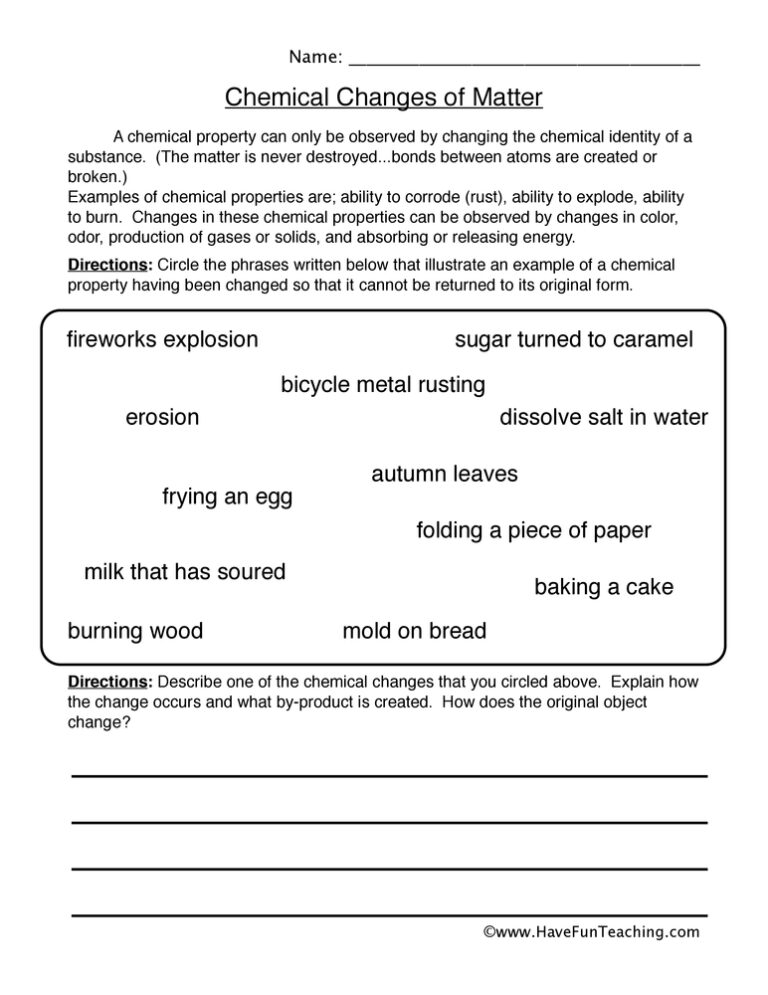
Worksheet5th GradeChemical Changes Matter Worksheet

This chemical changes matter worksheet has 5th grade students name the signs of a chemical change and explain their thinking with evidence. An answer key is included for quick, easy checking.

Worksheet
Worksheet5th GradeChemical Changes Examples Worksheet

This Chemical Changes Examples Worksheet gives 5th graders vocabulary practice, picture sorting, and a written explanation task for telling physical changes from chemical ones. An answer key is included, so checking work takes seconds.

Worksheet
Worksheet5th GradeMatter Worksheet

Use this matter worksheet to help 5th grade students decide what is and is not matter and explain mass, volume, and particles in writing. A full answer key is included.

Worksheet
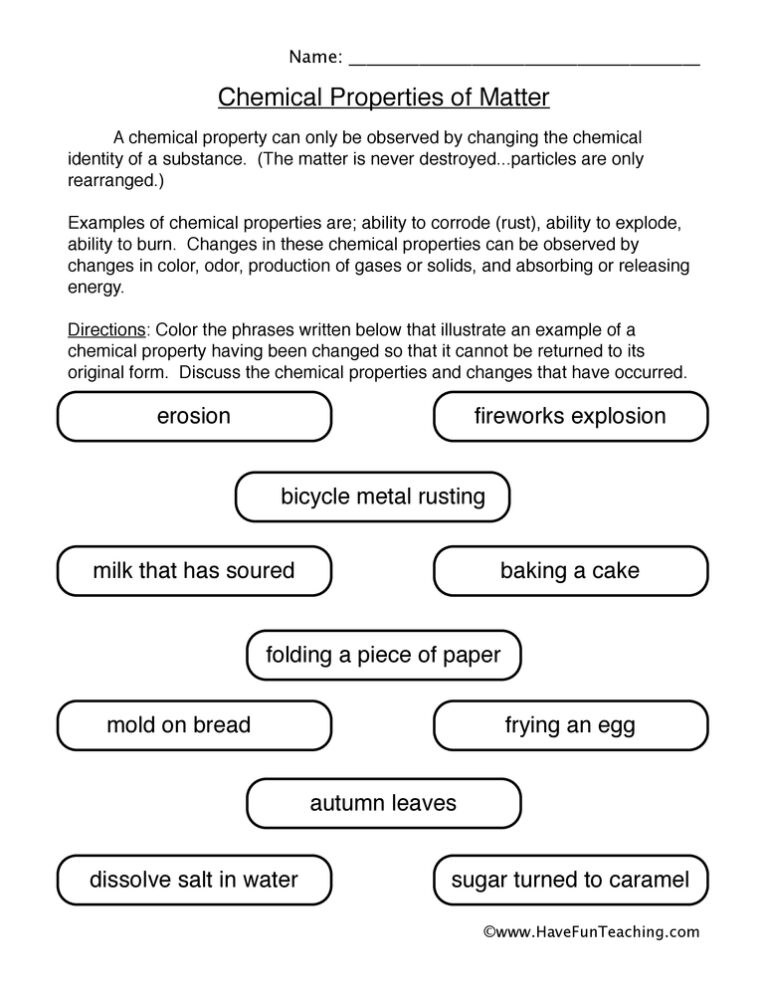
Worksheet5th GradeChemical Properties Matter Worksheet

This chemical properties matter worksheet has 5th grade students sort eight everyday events into chemical and physical changes, then explain their reasoning with evidence. An answer key is included for fast, no-prep science practice.

Worksheet
Worksheet5th GradeClassifying Matter Worksheet

This Classifying Matter Worksheet helps 5th graders sort substances into elements, compounds, and mixtures using a handy reference chart. Includes an answer key — perfect for no-prep physical science practice at home or in class.

Flash Cards
Flash Cards5th GradeMatter Word Wall

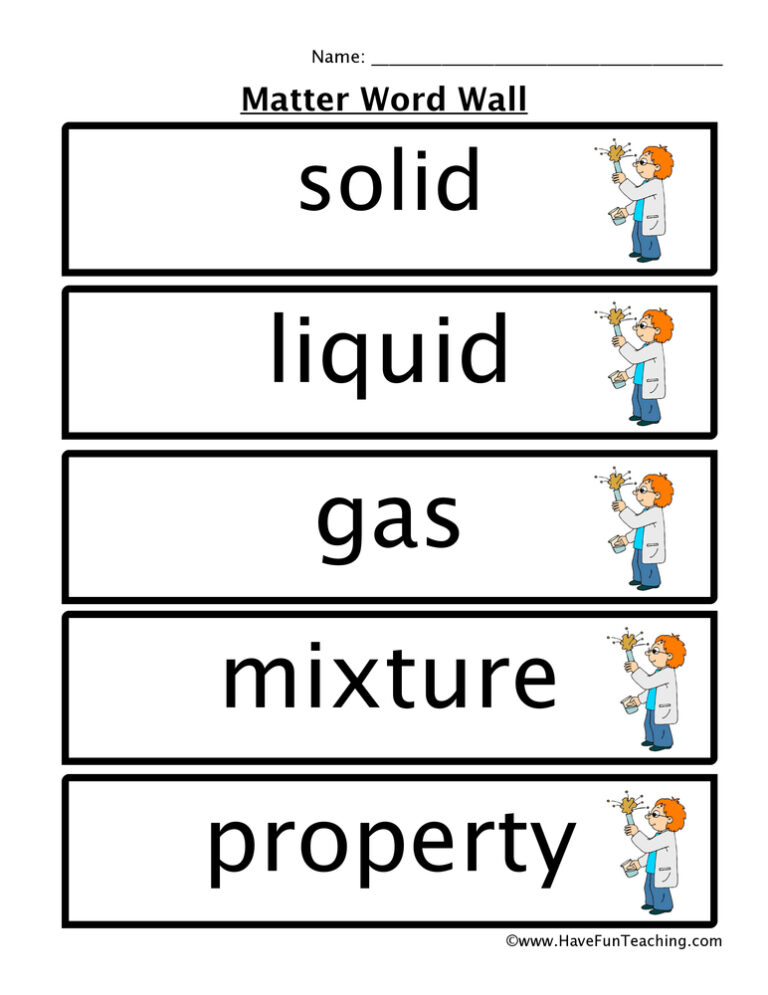
Matter word wall flash cards with 16 picture cards for solid, liquid, gas, melt, evaporate and more, for 2nd to 5th grade science. Answer key included for easy checking.

Song
Song5th GradeMatter Song (MP3)

While listening to the Matter Song (MP3), students learn about the states of matter, phases of matter, properties of matter, physical changes, chemical changes, solid, liquid, and gas and more.

From our teachers' playbook

Physical change or chemical change?

What do 5th graders learn about matter?

Fifth graders learn that all matter is made of particles too small to see, and that matter is never created or destroyed in a change: the total weight stays the same. They identify materials by properties like color, hardness, conductivity and solubility. Then they tell physical changes (melting ice, tearing paper, dissolving sugar) from chemical changes (baking a cake, rusting, burning), where a new substance forms. Clues like gas bubbles, a color change or heat give chemical changes away. The click comes when a student explains why a burnt marshmallow can never be turned back.

Our favorite ways to teach matter in 5th grade

Matter is best learned through careful observation. These moves give students the evidence.

Matter song warm-up

Use a matter song to review states and key vocabulary before a lab. Have students list every science word they hear and define two of them. Music makes the vocabulary memorable.

Why it works: a catchy, repeating tune gives the brain a hook to hang words on, so sung text is remembered better (Wallace, 1994).

Matter SongTry it withMatter SongSongsOpen it →

Classify by properties

Give groups a tray of materials and have them test and classify by properties: magnetic, dissolves in water, conducts heat. They record results in a table. Testing builds real understanding of properties.

Why it works: kids understand an idea best when they touch it, then draw it, then write it, the order the U.S. Department of Education recommends for elementary math.

Classifying Matter WorksheetTry it withClassifying Matter WorksheetWorksheetsOpen it →

Change sort

Show photos of changes and have students vote physical or chemical, then name the evidence. A quick sort at the start of class shows who is confusing dissolving with a chemical change.

Why it works: researchers who compared ten study methods found practice testing is one of the two that work best (Dunlosky and colleagues, 2013).

Physical Changes Examples WorksheetTry it withPhysical Changes Examples WorksheetWorksheetsOpen it →

Matter questions parents and teachers ask

What is the difference between a physical and a chemical change?

A physical change alters the form or state of matter but not what it is, like melting ice. A chemical change creates a new substance, like baking bread or rust forming.

What are signs of a chemical change?

Common signs include gas bubbles, a new color, a new smell, light or heat being given off, and a solid forming from liquids.

What do 5th graders learn about matter?

They learn that matter is made of tiny particles, identify materials by properties, distinguish physical and chemical changes, and learn that total weight stays the same when matter changes.

What are easy matter experiments at home?

Dissolve sugar in water and evaporate it, mix baking soda and vinegar, or watch an apple slice turn brown. Talk about whether each change made something new.



