Skip to content
Start My 3 Free Days $0 today · cancel anytime

Division Activities

21 division activities. Teacher favorites: Doghouse Division Activity and Multiplication Comparison Activity. How teachers use these

Division Activities

21 division activities. Teacher favorites: Doghouse Division Activity and Multiplication Comparison Activity. How teachers use these

Activity
Activity3rd GradeDoghouse Division Activity

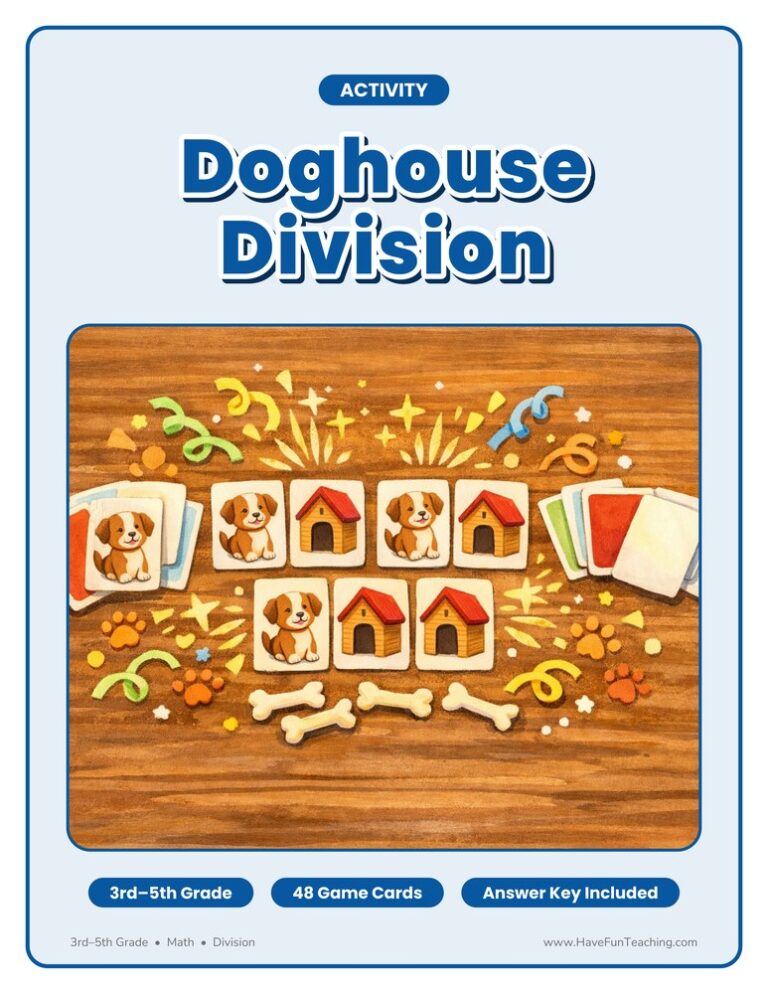
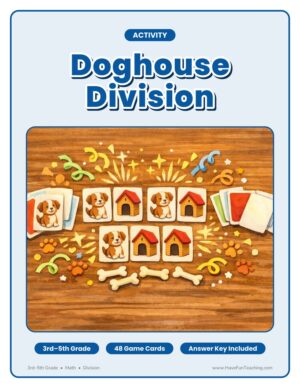
This doghouse division activity has 3rd to 5th grade students match puppy division cards to doghouse answer cards, then check with multiplication. Answer key included.

Activity
Activity4th GradeMultiplication Comparison Activity

This multiplication comparison activity for 4th and 5th Grade has students match seaside word problems to equations and solve for the unknown. Answer key included for quick checking.

Activity
Activity3rd GradeSolving Division Activity

This solving division activity has 3rd and 4th grade students match equation cards to answer cards to find missing numbers in multiplication and division facts. Answer key included for quick checking.

Activity
Activity3rd GradeSolving Multiplication Activity

This solving multiplication activity has students match equation cards to answer cards to find the unknown number. Made for 3rd-4th grade with a practice page and answer key included.

Activity
Activity3rd Grade3.OA.7 Common Core Activity

This 3.OA.7 Common Core activity has 3rd-4th grade students match snowflake problem cards to fish answer cards to find unknown numbers, with a practice page and answer key included.

Activity
Activity3rd GradeArithmetic Theme Park Multi-Step Word Problems Activity

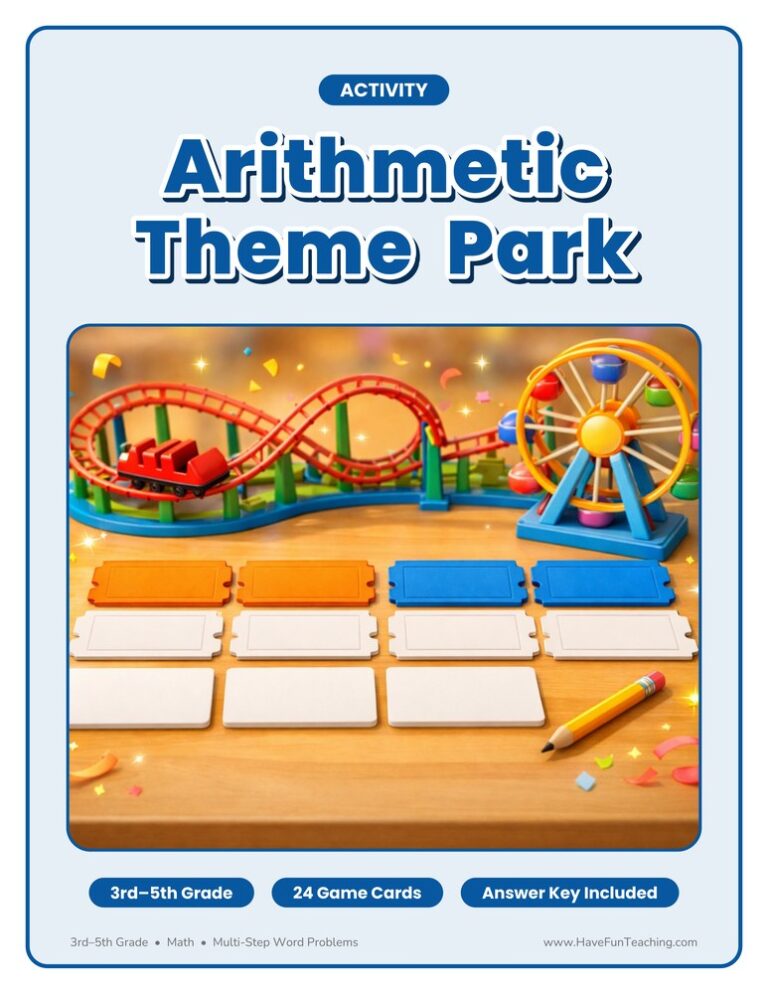
This arithmetic theme park multi-step word problems activity has 3rd to 5th graders solve ticket problems and match each answer to a ride. Answer key included.

Activity
Activity3rd GradePenguins Multiplication Division Properties Activity

Using Penguins Multiplication Division Properties Activity, students explain why multiplication and division strategies work.

Activity
Activity2nd GradeMystery Monster Math Unknown Factors Activity

Using this Mystery Monster Math Unknown Factors Activity, students understand division as an unknown factor problem to build multiplication fact fluency.

Activity
Activity3rd GradeReal World Word Problems Activity

This real world word problems activity helps 3rd and 4th grade students match two-step farm word problems to equations and solve them. A recording sheet, practice page and answer key are included.

Activity
Activity2nd GradeBe the Baker Multiplication Activity

Using this Be the Baker Multiplication Activity, students interpret products of whole numbers into equal groups.

Activity
Activity3rd GradeExploring Word Problems Activity

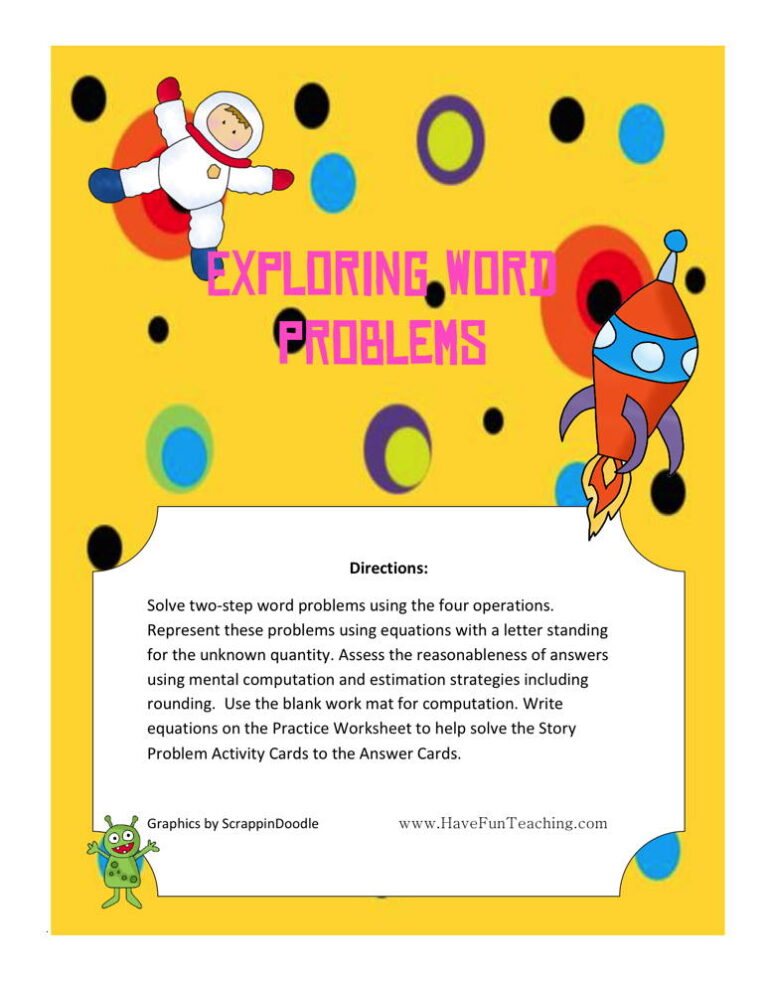
This exploring word problems activity has children match 12 two-step camping word problems to equations with a letter for the unknown. Made for 3rd and 4th grade, with a practice page and answer key included.

Activity
Activity3rd GradeRoad Race Multiplication Division Activity

This road race multiplication division activity is a board game for 3rd and 4th grade with 20 self-checking cards for finding the missing number. A practice page and answer key are included.

Activity
Activity4th GradeDown in the Sea Division Activity

This down in the sea division activity has 4th and 5th Grade students sort 18 equation cards by quotients of 10, 100 and 1,000 using place value. Answer key included.

Activity
Activity4th GradeMaking Inferences Math Operations Activity

This making inferences math operations activity helps 4th and 5th grade students use clue words to choose the right operation and solve word problems. An answer key is included for quick checking.

Activity
Activity2nd GradeSharing with Whole Numbers Division Activity

Using this Sharing with Whole Numbers Division Activity, students interpret whole numbers as the number of objects in each share.

Activity
Activity3rd GradeQuotient Quickies Division Activity

This Quotient Quickies Division activity has 3rd-4th grade students match wave division cards to whale quotient cards and write the related times fact, with a practice page and answer key included.

Activity
Activity3rd GradeMouses Missing Numbers Multiplication Division Activity

This Mouses Missing Numbers Multiplication Division activity has 3rd-4th grade students match cheese problem cards to mouse answer cards, with a practice page and answer key included.

Activity
Activity3rd GradeWho Can Divide Word Problems Activity

This who can divide word problems activity for 3rd and 4th Grade has kids match one- and two-step division problems to equations and solve. Answer key included.

Activity
Activity5th Grade5.NBT.6 Common Core Activity

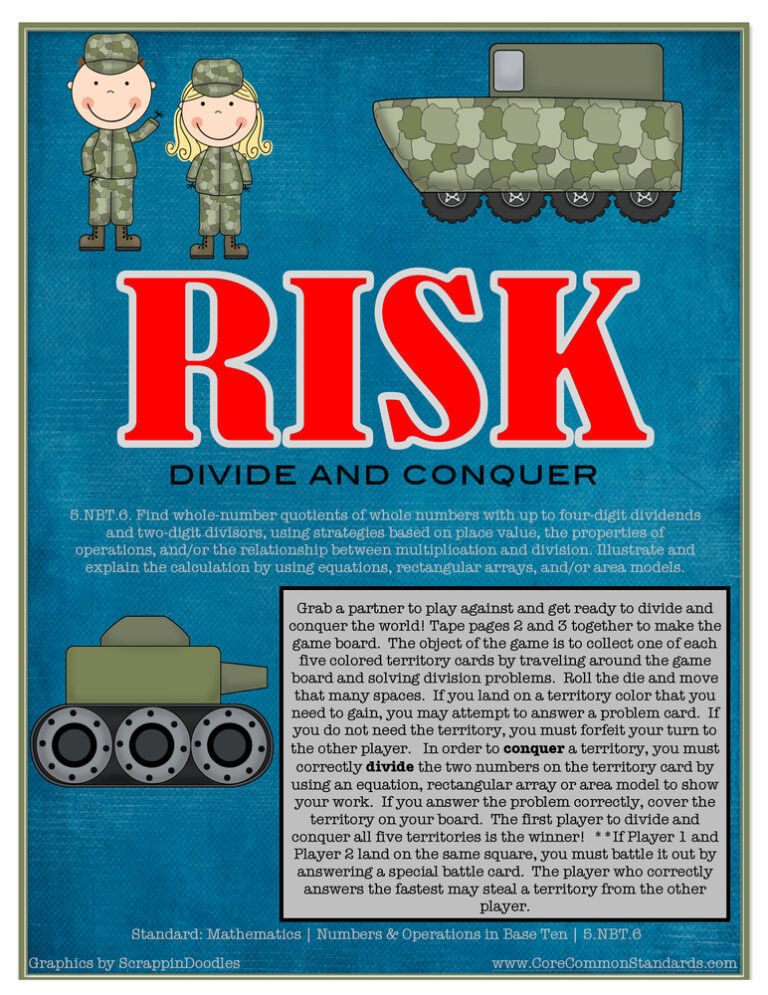
In this 5.NBT.6 Common Core Activity, students find whole-number quotients of whole numbers with up to four-digit dividendsand two-digit divisors.

Activity
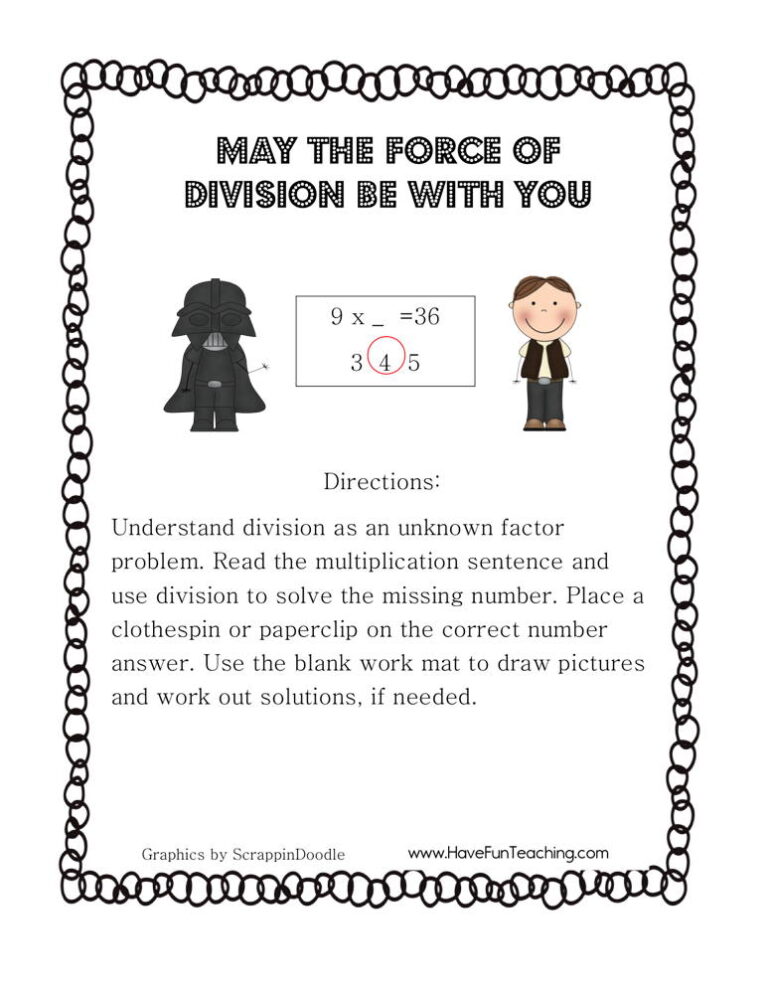
Activity2nd GradeMay the Force of Division Be With You Activity

Using this May the Force of Division Be With You Activity, students understand division as an unknown factor problem to build multiplication fact fluency.

From our teachers' playbook

Fair shares, every single time.

What do kids learn about division?

Division starts with a simple idea kids already know: sharing fairly. In 3rd grade, students learn that 12 ÷ 3 = 4 can mean 12 cookies shared by 3 friends, or 12 cookies put in bags of 3. They connect it to multiplication through fact families and build fluency with facts to 100. In 4th grade they divide bigger numbers by one digit and meet remainders, and in 5th grade they tackle two-digit divisors with long division. The click moment is when kids realize division is just multiplication asking a missing-number question: 3 × ? = 12.

Our favorite ways to make division make sense

Division gets easier when kids see the sharing, know their facts and follow a clear routine for the big problems.

Share it out first

Before any symbols, give kids 20 counters and 4 paper plates and say "Share these fairly." Then switch: "Make groups of 4. How many plates do you need?" Doing both kinds of division with real objects is what makes the ÷ sign mean something.

Why it works: kids understand an idea best when they touch it, then draw it, then write it, the order the U.S. Department of Education recommends for elementary math.
Doghouse Division ActivityTry it withDoghouse Division ActivityActivitiesOpen it →

Facts in a flash

Long division falls apart when facts are slow. Run a quick daily fact round with division facts only, and have kids circle the ones that made them pause. Those circled facts become tomorrow's warm-up.

Why it works: researchers who compared ten study methods found practice testing is one of the two that work best (Dunlosky and colleagues, 2013).

Division Fact Fluency WorksheetTry it withDivision Fact Fluency WorksheetWorksheetsOpen it →

One routine, every time

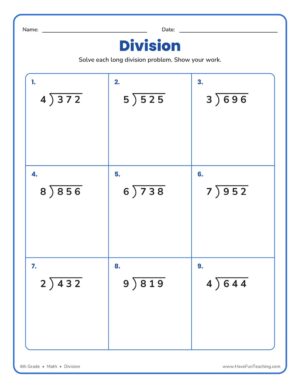
Teach long division with the same four steps every time: divide, multiply, subtract, bring down. Model one problem slowly while thinking aloud, then have kids say the steps with you on the next one. Colored pencils for each step help kids keep track of where they are.

Why it works: showing first, practicing together, then letting kids try alone is the "gradual release" model teachers have relied on for decades (Pearson and Gallagher, 1983).

Long Division WorksheetTry it withLong Division WorksheetWorksheetsOpen it →

Questions parents and teachers ask us

What grade do kids learn division?

Most children start division in 3rd grade with sharing and facts to 100. Dividing larger numbers comes in 4th grade, and long division with two-digit divisors in 5th grade.

How do I explain division to a child?

Start with sharing. Ask "If we share 15 grapes between 3 people, how many does each get?" and let them deal the grapes out. Then show that 15 ÷ 3 = 5 is just a short way to write what they did.

Should my child memorize division facts?

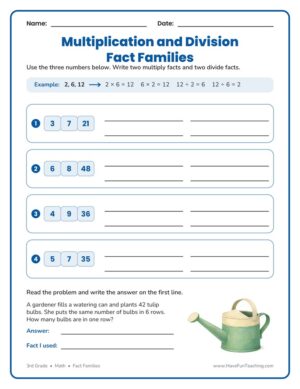
Yes, but through multiplication. If a child knows 6 × 8 = 48, they also know 48 ÷ 6 = 8. Practicing fact families together is faster than memorizing division facts on their own.

What is a remainder?

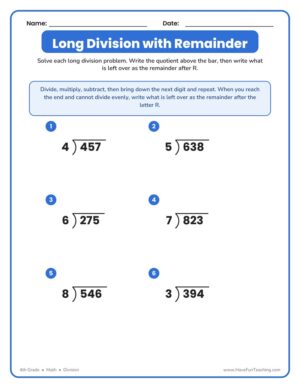
A remainder is what is left over when a number can't be shared equally. 14 ÷ 4 = 3 with 2 left over, because 4 groups of 3 use 12 and 2 are left.

Why is long division so hard for kids?

It packs several skills into one problem: facts, multiplication, subtraction and place value. If a child struggles, check which step is breaking down. Usually it is slow facts or lining up the digits.