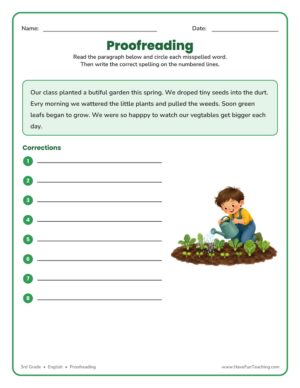
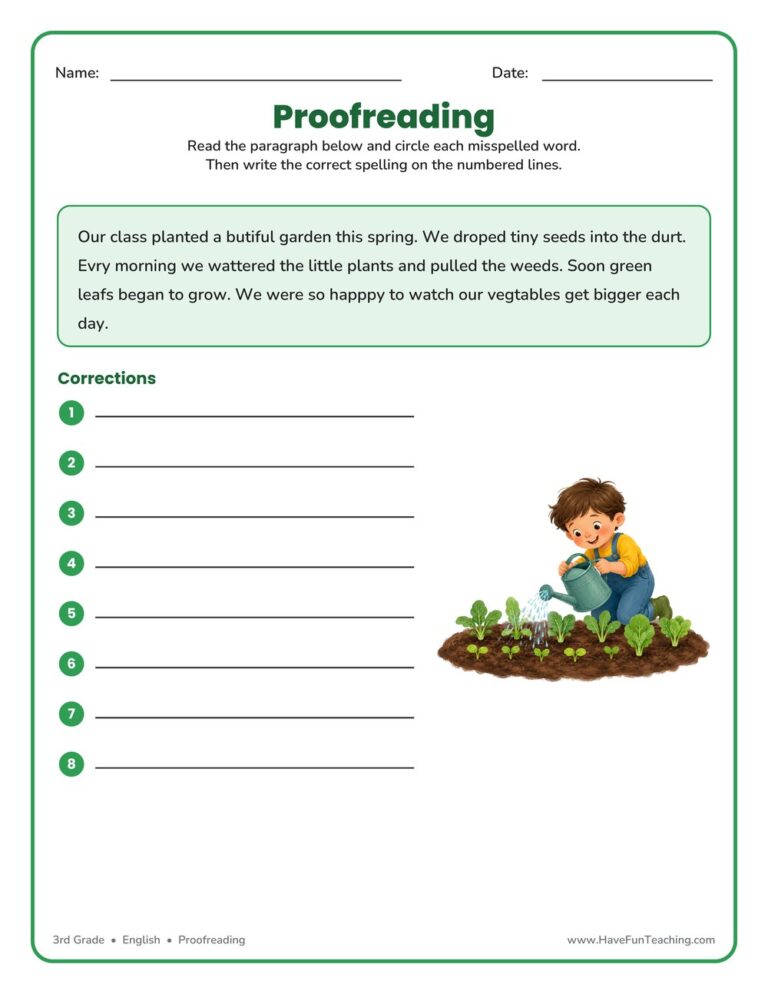
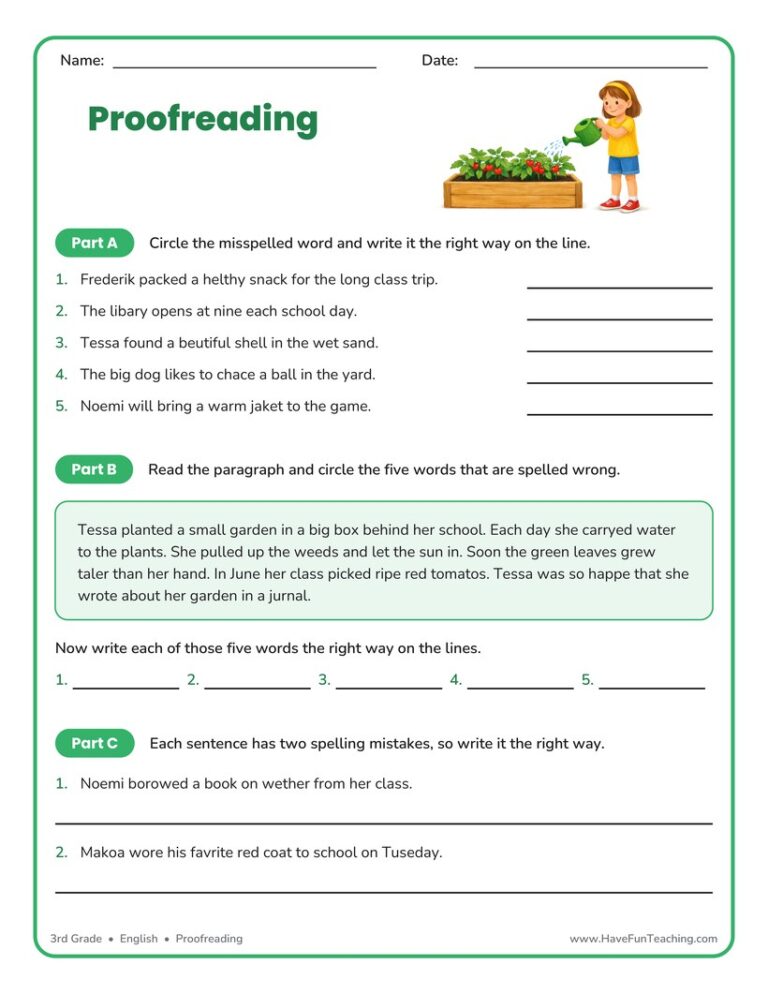
This 3rd grade proofreading worksheet has students hunt for and fix eight misspelled words in a fun garden paragraph. Answer key included — perfect for quick, no-prep spelling and editing practice at home or school.
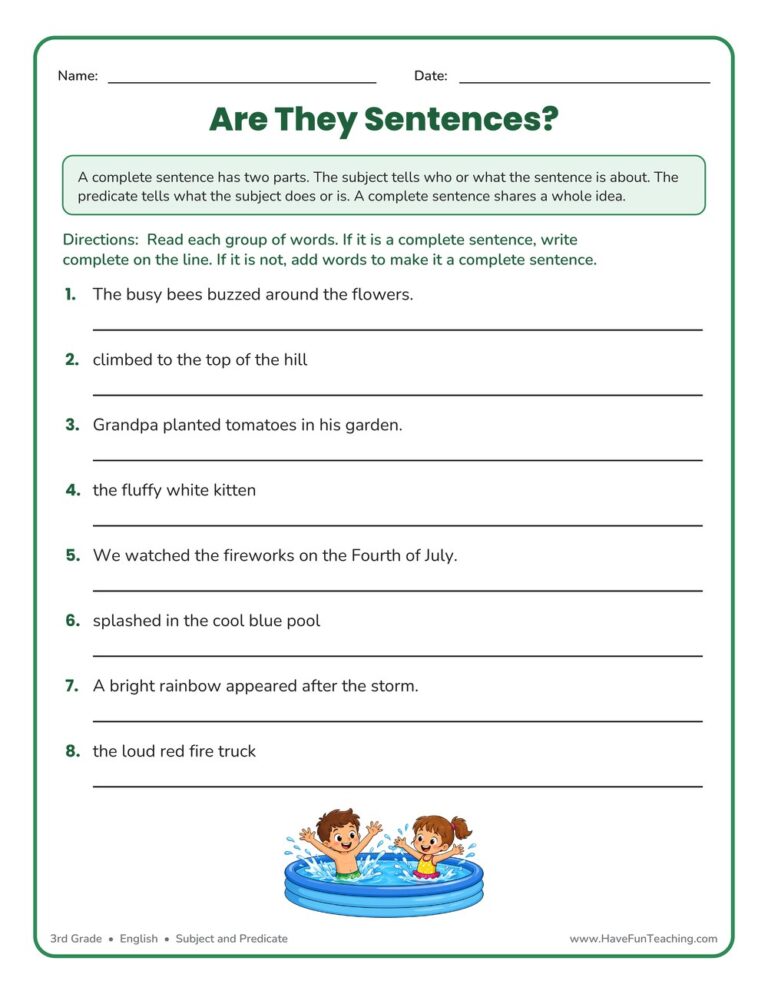
This Creating Complete Sentences Worksheet asks 3rd graders to spot complete sentences and fix fragments by adding a missing subject or predicate. Answer key included — perfect for quick, no-prep grammar practice at home or school.
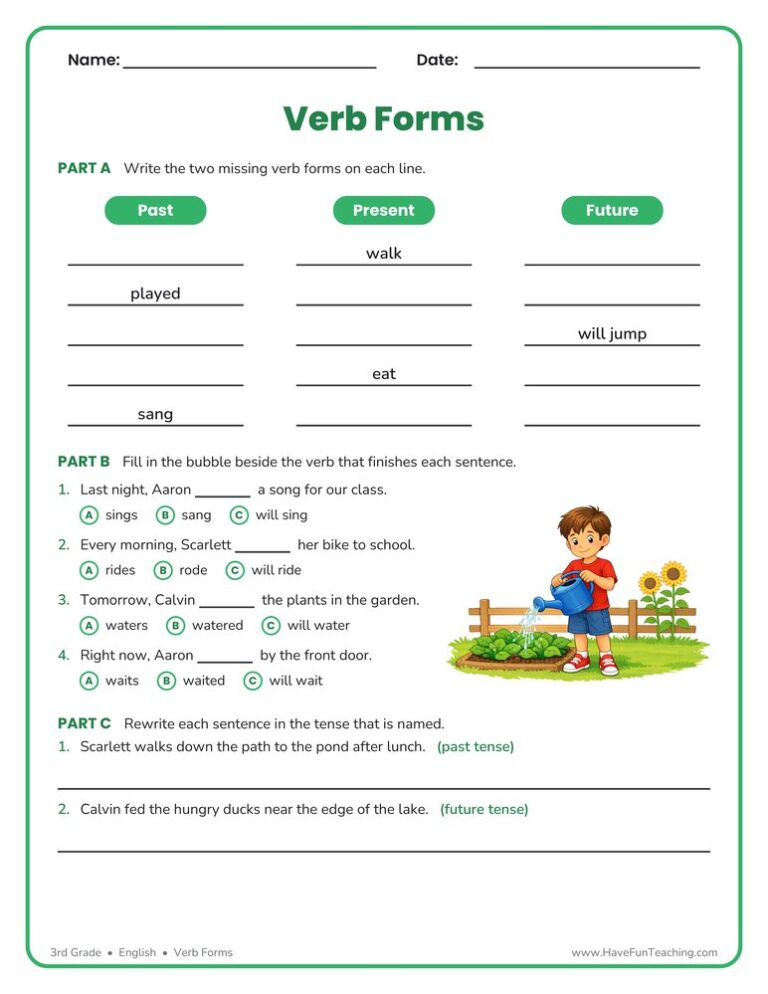
A three-part verb forms worksheet that has 3rd graders complete a past, present, and future chart, pick the right verb for each sentence, and rewrite sentences in a new tense. Answer key included for fast checking.
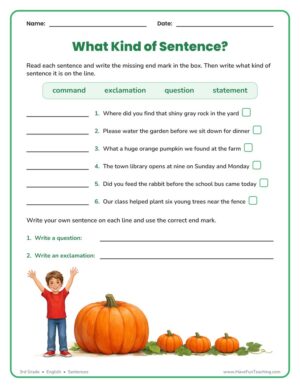
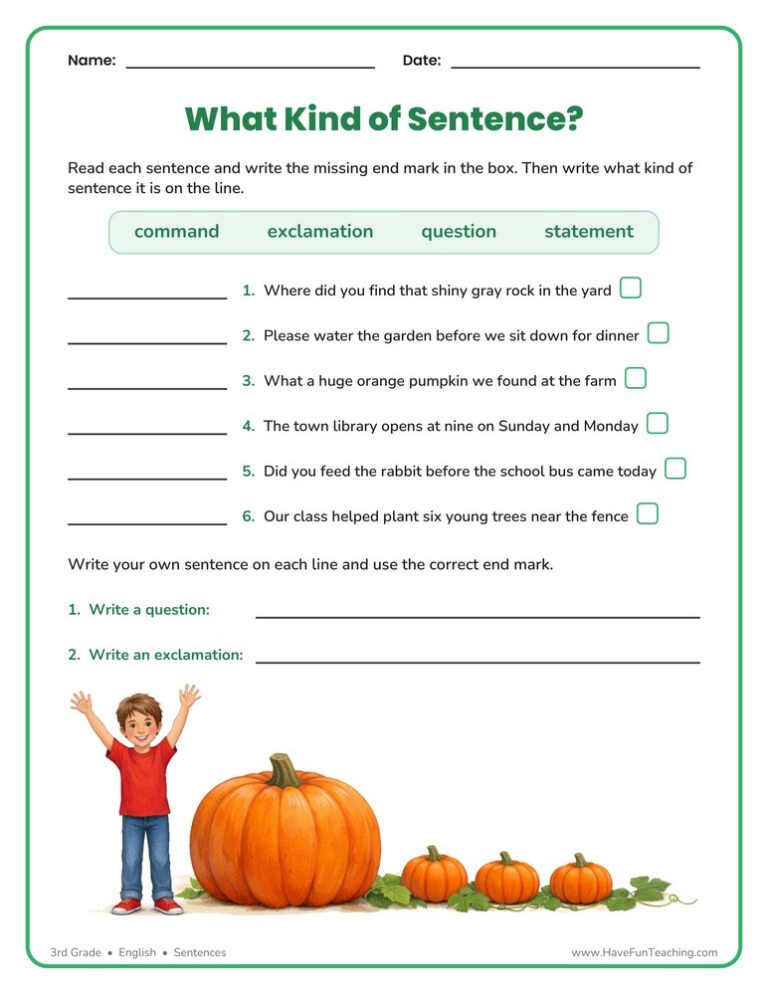
With this What Kind of Sentence? Worksheet, 3rd Grade students add the missing end mark and label each sentence as a statement, question, command, or exclamation. An answer key is included, so practice is quick to check.
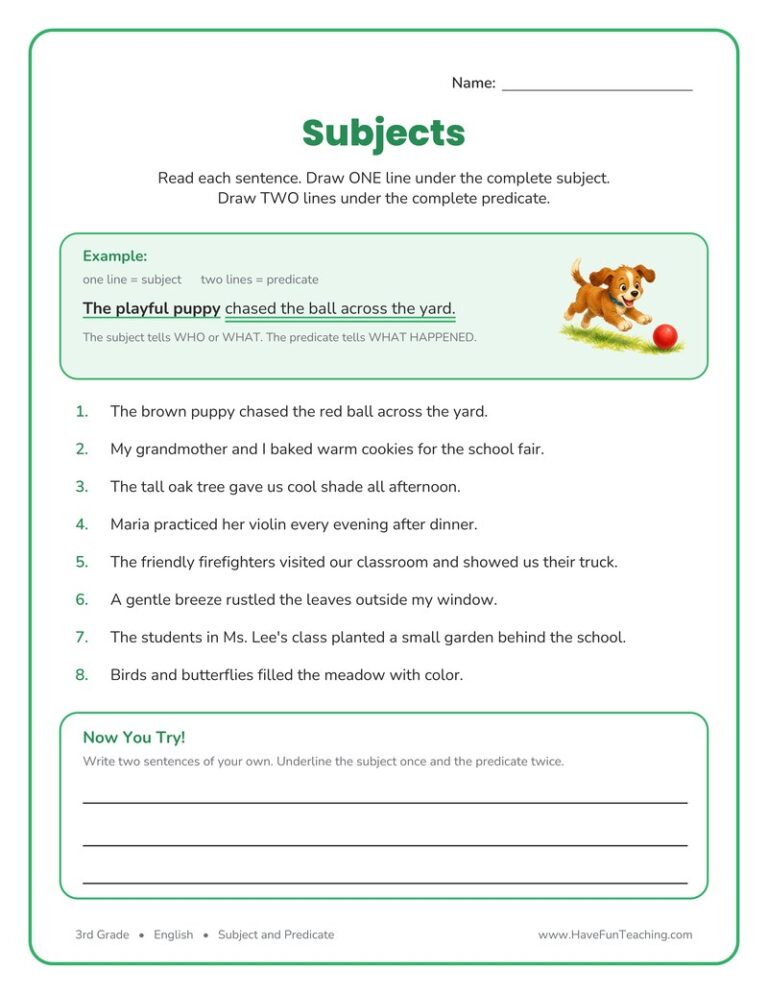
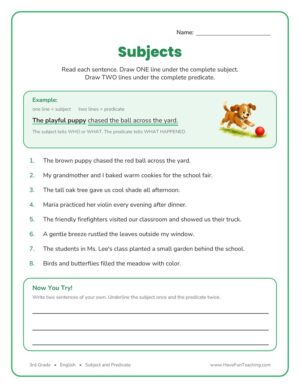
A 3rd grade subject predicate worksheet where kids underline the subject and predicate in eight sentences, then write their own. Includes a full answer key for quick, confident grammar practice.
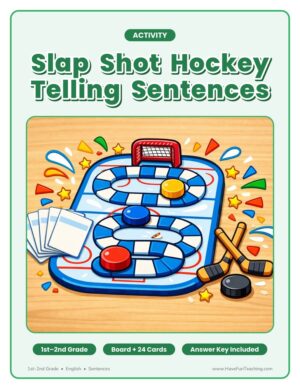
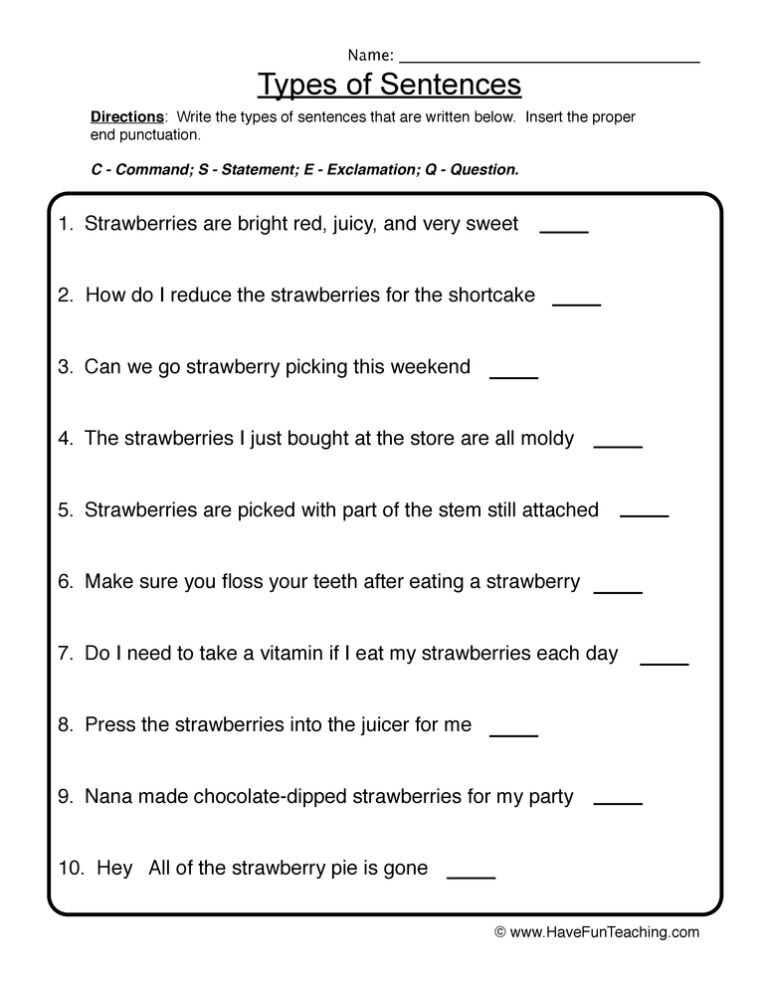
Students use this identifying types of sentences worksheet to add end marks, label each sentence, and rewrite one type as another. Built for 3rd Grade, with an answer key included.
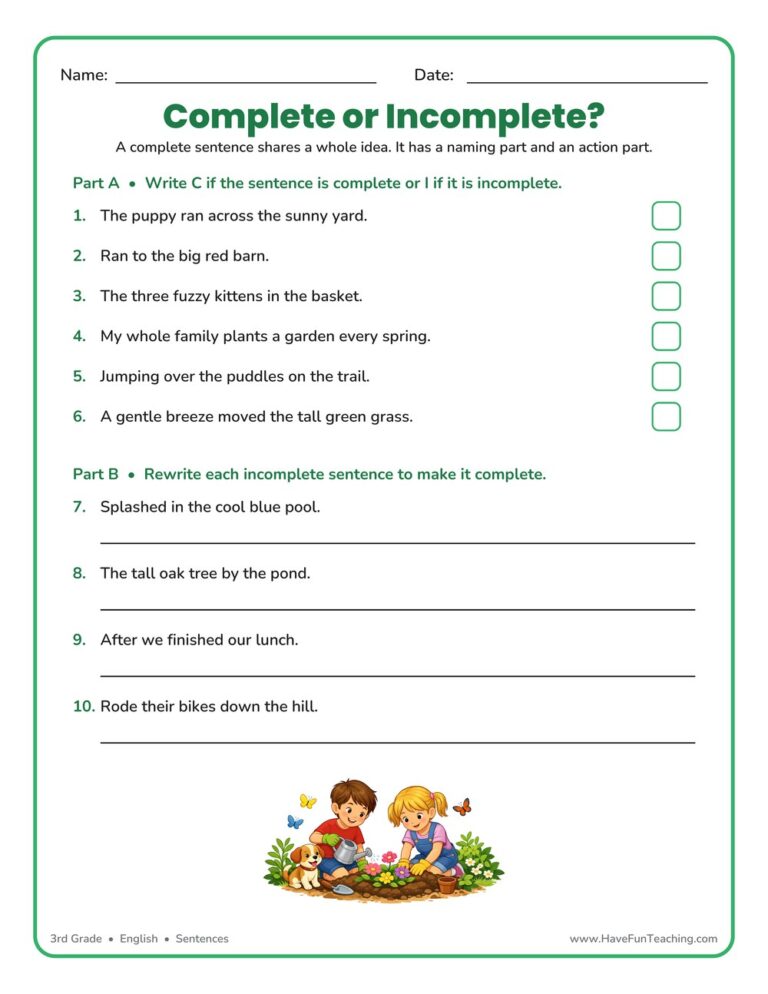
This rewriting incomplete sentences worksheet helps 3rd graders sort complete and incomplete sentences, then rewrite the fragments into full thoughts. Includes an answer key for fast, no-prep grammar practice at home or school.
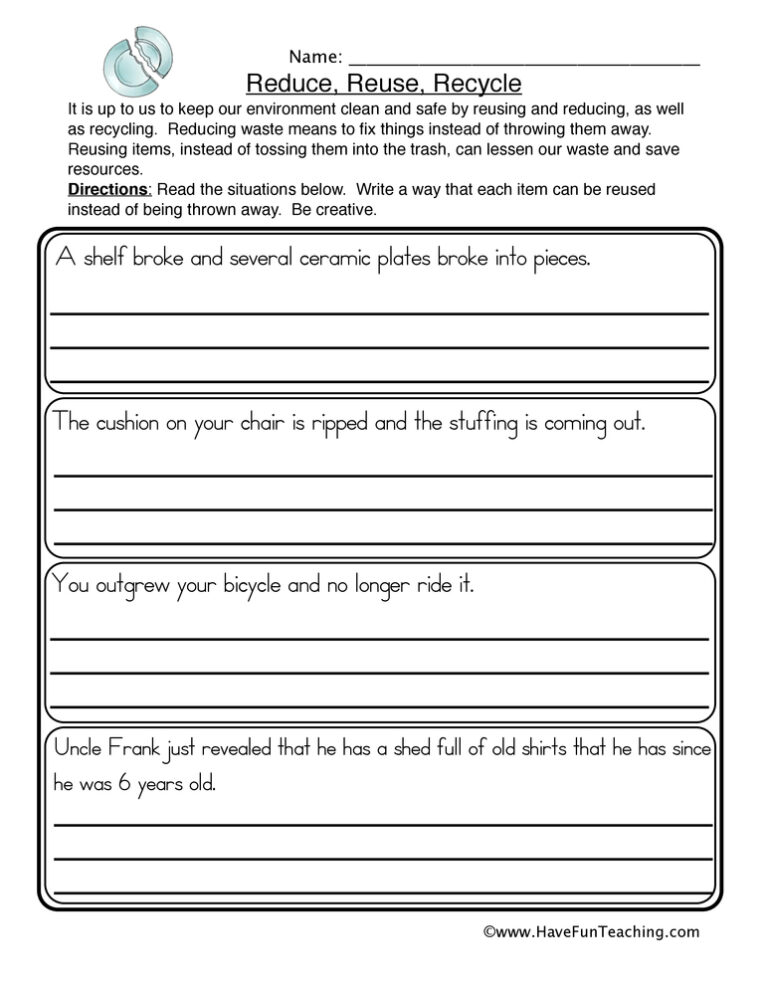
Read six real-life situations and decide whether each one shows reducing, reusing, or recycling on this reduce, reuse, recycle scenarios worksheet for 3rd grade. Answer key included, so Earth Day science practice takes no prep.
This proofreading capitalization and punctuation activity gives 2nd to 5th grade students 16 self-checking detective cards for fixing sentences. A practice page and answer key are included.
Third graders proofread five sentences, a short paragraph, and two rewrites to catch and fix misspelled words with this proofreading spelling errors worksheet. An answer key is included for quick checking.
This complete sentences with subject and predicate activity has 1st to 3rd grade students match picture subject cards to predicate cards, then practice on a worksheet. Answer key included.
This rewriting subject predicate sentences worksheet has 3rd graders swap an underlined subject or predicate for a new one and write the sentence again. An answer key is included for fast, no-prep grammar practice.
This writing in verb forms worksheet has 3rd grade students rewrite sentences with each verb in the past or future tense. An answer key is included, so practice with regular and irregular verbs is quick to check.
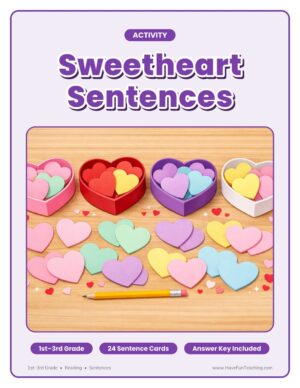
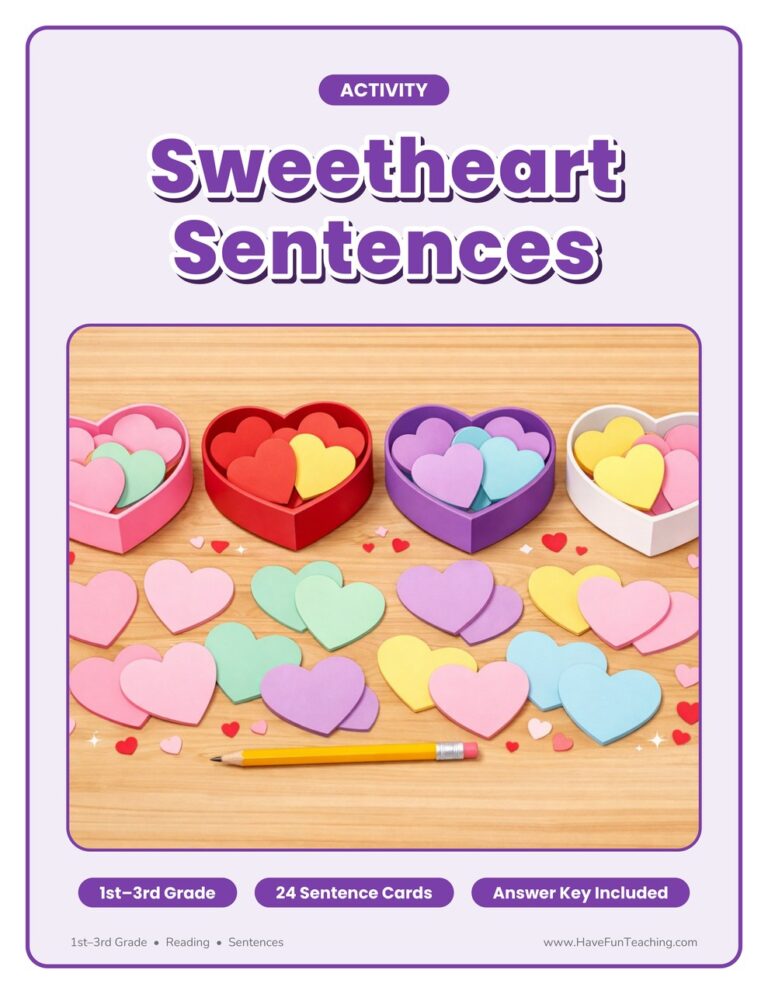
This sweetheart sentences activity lets 1st to 3rd grade children sort Valentine heart cards into statements, questions, exclamations and commands while building strong grammar skills. Answer key included.
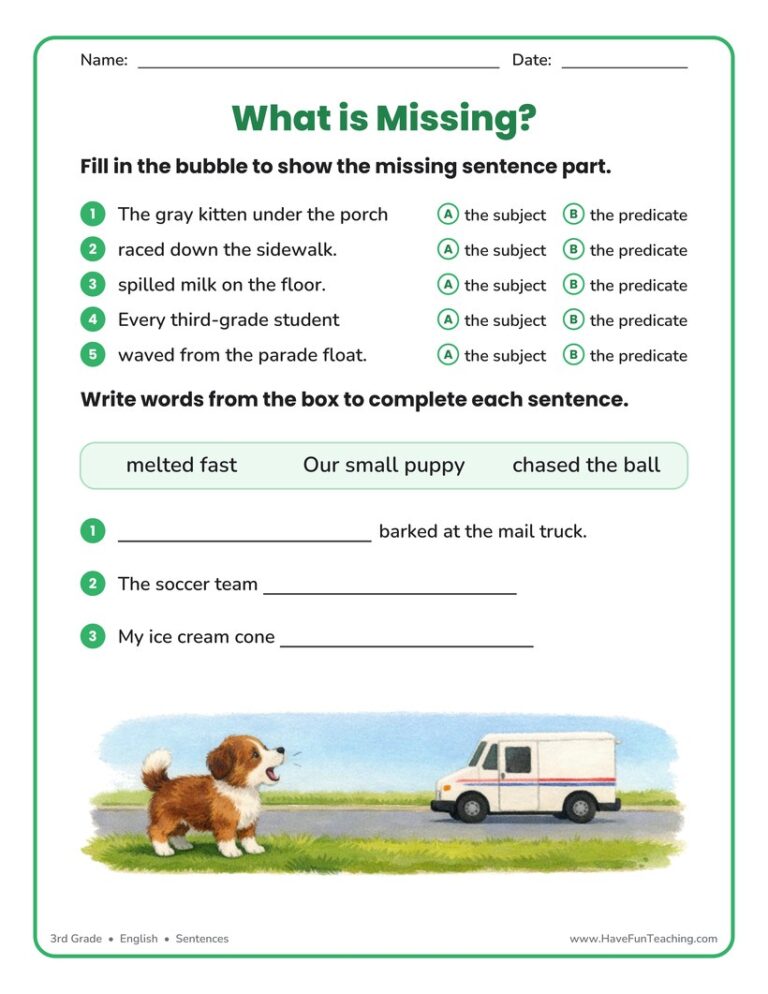
A 3rd grade What is Missing? Complete Incomplete Sentences Worksheet where students decide whether the subject or predicate is missing, then finish each sentence from a word box. Answer key included for fast, no-prep grammar practice.
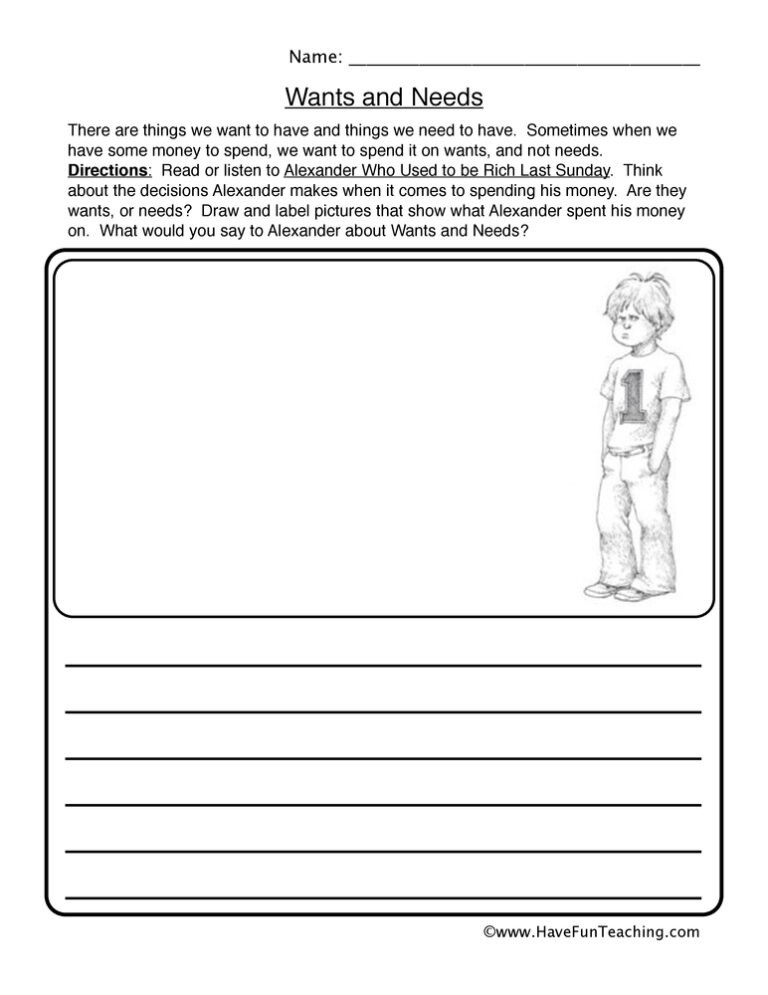
Using this Wants Needs Reading Response Worksheet, students readAlexander Who Used to be Rich Last Sunday to build their understanding of wants and needs.
Third graders learn that every complete sentence needs two parts: a subject (who or what) and a predicate (what they do or are). The hungry puppy | chewed my shoe. They sort sentences into four kinds: telling, asking, commanding and exclaiming, and they match each one with the right end mark. They fix fragments and run-ons, and start joining two simple sentences with words like and, but and so to make compound sentences. The click moment is when kids can read their own writing and hear where a sentence is missing a piece.
Our favorite ways to teach sentences
Good sentences are the building blocks of good writing, so we give kids lots of chances to build, sort and fix them.
Split it down the middle
Write a sentence on a sentence strip and literally cut it between the subject and the predicate. Mix up a pile of halves and let kids build new, silly sentences like "My teacher | swam across the lake." Then they practice on the subject and predicate worksheet.
Why it works: showing first, practicing together, then letting kids try alone is the "gradual release" model teachers have relied on for decades (Pearson and Gallagher, 1983).
Read a sentence aloud with expression and kids hold up a card: period, question mark or exclamation point. Then ask which kind it is. A quick daily round builds the habit fast.
Why it works: researchers who compared ten study methods found practice testing is one of the two that work best (Dunlosky and colleagues, 2013).
Give kids a short paragraph with missing capitals, missing end marks and a run-on or two. They fix everything with a colored pen. Mixing all the sentence errors together is what prepares them to edit their own writing.
Why it works: shuffled practice teaches kids to choose the right strategy, not just repeat one, and it improved test scores in research (Rohrer and Taylor, 2007).
A complete sentence has a subject, a predicate and expresses a full thought. It starts with a capital letter and ends with a period, question mark or exclamation point.
What are the four types of sentences?
Declarative sentences tell something, interrogative sentences ask, imperative sentences give a command and exclamatory sentences show strong feeling. Third graders often learn them as telling, asking, command and exclaiming sentences.
What's the difference between a fragment and a run-on?
A fragment is missing a part, like "Ran to the bus." A run-on squeezes two sentences together without the right punctuation. Kids fix fragments by adding the missing piece and fix run-ons by splitting or joining them correctly.
How do I help my child write better sentences?
Have them read their writing out loud. Kids often hear a missing word or a run-on before they see it. Then ask, "Who is this about, and what did they do?"
Do 3rd graders learn compound sentences?
Yes, many 3rd graders start combining two simple sentences with words like and, but, or and so. It's a big step toward more interesting writing.
Written by the Have Fun Teaching team of elementary teachers and homeschoolers. Research: Pearson, P. D., & Gallagher, M. C. (1983). The instruction of reading comprehension. Contemporary Educational Psychology, 8(3). Dunlosky, J., Rawson, K. A., Marsh, E. J., Nathan, M. J., & Willingham, D. T. (2013). Improving Students' Learning With Effective Learning Techniques. Psychological Science in the Public Interest, 14(1). Rohrer, D., & Taylor, K. (2007). The shuffling of mathematics problems improves learning. Instructional Science, 35(6).
3 days free
2:39Ready to print!
Printables · Songs · Games
Loved by 2 million teachers & families
Where learning feels like play.
Printables, songs and games for every subject, Preschool through 6th. Ready to teach today, and kids beg for more.
$0due today
then $39.97$35.97for your first year, and $39.97 a year after that.




 Try it withSubject Predicate WorksheetWorksheetsOpen it →