

Five Senses Examples Worksheet
This Five Senses Examples Worksheet has 2nd graders sort ten sensory adjectives by sight, sound, smell, taste, and touch. An answer key is included, so describing words get easier fast.
$6.97
Or free with a membership — members pay $3.33/mo for all 10,000+ resources. See plans
Want this one free?
Tell us where to send it and it’s yours — no card, no catch.
One free resource per teacher. We’ll also send free teaching ideas each week — unsubscribe anytime.
Teaching is easier with a membership
Unlimited printables, games & videos for PreK–6th — for your classroom or homeschool. Cancel anytime.
Start your 3-day free trial$0 today · cancel anytime · Instant access to 10,000+ resources
About this resource
Description
Learning to describe the world begins with the five senses, and this Five Senses Examples Worksheet turns that everyday experience into real adjective practice. Second graders already know that popcorn smells buttery and a kitten feels soft, but they need practice naming those describing words and connecting each one to the sense that notices it. Sorting sensory adjectives by sight, sound, smell, taste, and touch builds the precise vocabulary students need for stronger sentences, better science observations, and clearer writing all year long.
Using this five senses examples worksheet, students read a word box of ten sensory adjectives and write each word underneath the sense it tells about. Five illustrated sense boxes give a picture clue for every category, so children can check their thinking as they sort. A second activity asks students to circle the sense word inside a sentence and then write which sense it belongs to, moving the skill from single words into real reading. Print it, hand it out, and let students work independently, with a partner, or in a small guided group.
What’s Included
- One printable 2nd grade worksheet in PDF format, ready to print
- A word box of ten sensory adjectives to sort
- Five illustrated sense boxes with two writing lines each
- Three sentences for circling and naming the sense word
- A complete answer key on the final page
This 2nd grade adjectives worksheet helps children in three important ways. First, it grows describing vocabulary, giving students exact words to reach for instead of “good” or “nice.” Second, it strengthens the science habit of careful observation, because naming a sense is the first step in recording what you notice. Third, the sorting format makes thinking visible, so a teacher can see at a glance which senses a student still confuses.
Teachers and parents can stretch this activity in simple ways. Pass around a lemon slice, a drum, or a fuzzy toy and have students add new words to each sense box. Take the page outside and collect ten fresh adjectives from the playground. Challenge early finishers to write their own sentence using one word from the box, then trade papers and circle each other’s sense words. Store the answer key for quick checking or for a self-correcting center.
Related Resources
What teachers say
Reviews
You must be logged in to post a review.
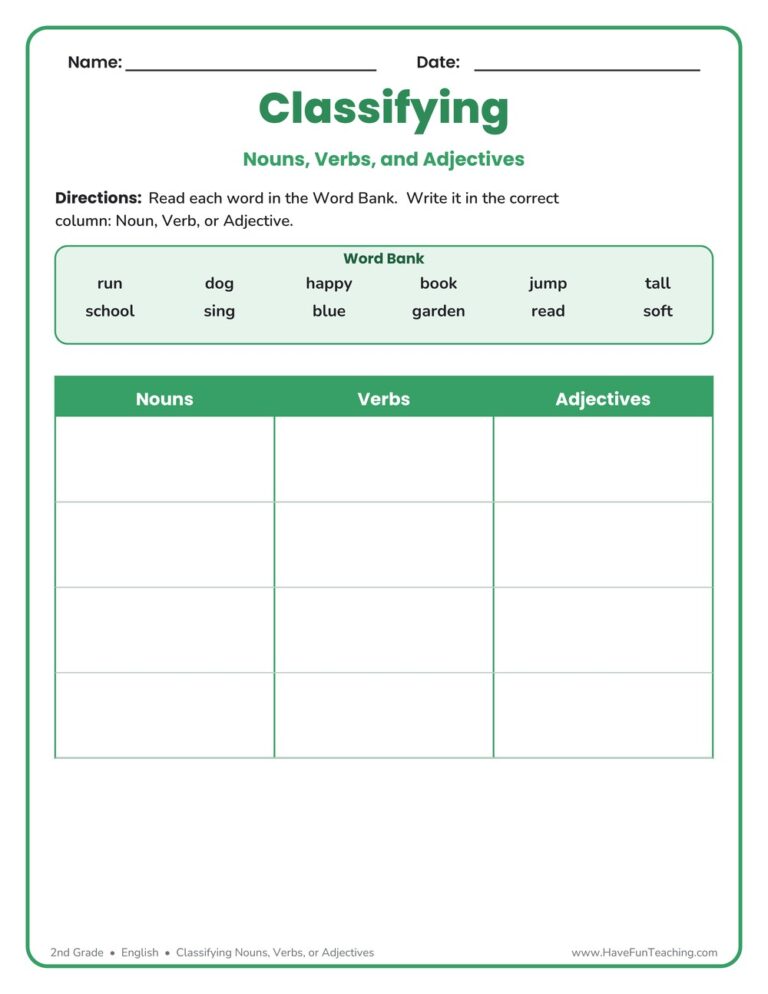
Sort twelve everyday words into nouns, verbs, and adjectives with this Classifying Nouns, Verbs, or Adjectives Worksheet for 2nd grade. Includes a complete answer key for quick, no-prep grammar practice.
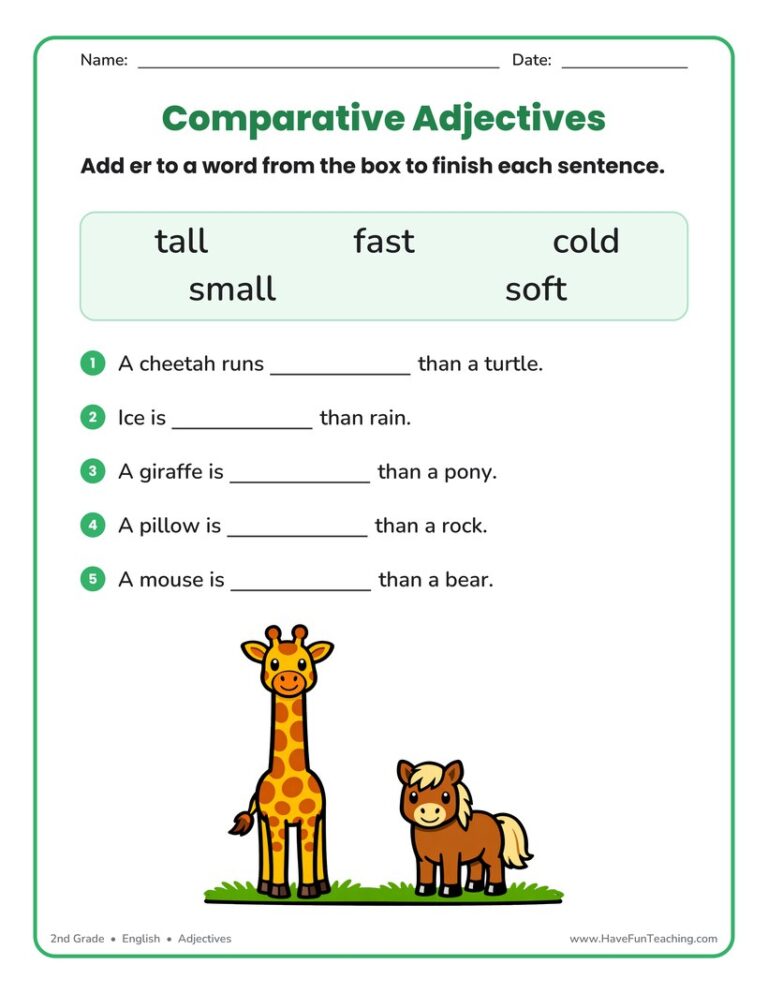
This Comparing Adjectives Fill in Blank Worksheet asks 2nd Grade students to add er to a word from the box and finish five comparing sentences. Answer key included for quick checking.

Using Experience Narrative Worksheet, students dictate, write, or draw about a time in their lives to give descriptive information.

This Adding Adjectives Worksheet gives 2nd grade students fun practice finding, choosing, and writing describing words in sentences. An answer key is included, so learning to use adjectives feels clear and rewarding.

This Adjectives Fill in the Blank Worksheet gives 2nd Grade students practice choosing, circling, and writing describing words in real sentences. An answer key is included, so checking work takes seconds.

Using Adjective Flash Cards, students describe pictures using adjectives to build vocabulary and writing skills.

This Adjectives Pictures Worksheet asks 2nd graders to choose the adjective that fits each picture, then write two describing words of their own. Answer key included, so grading takes seconds.

This Adjectives Puppy Story Worksheet has 2nd graders read a short story about a puppy, circle all 8 adjectives, then match each one to the noun it describes. Answer key included for fast, no-prep grammar practice.

This descriptive words worksheet gives 2nd grade students a word box of four adjectives to finish picture sentences, then four more sentences to hunt the adjective in. An answer key is included, so children can check their own work.

This Adjectives Sort Worksheet asks 2nd graders to file twelve describing words under Feelings, Tastes, or Sizes. Answer key included, so grammar practice is ready in one print with no prep.

This Complete the Sentence with an Adjective Worksheet gives 2nd Grade students five word-box sentences plus four circle-and-underline sentences. An answer key is included, so describing-word practice is ready in minutes.

Students rewrite sentences by adding a describing word in this Adjectives Sentence Rewriting Worksheet for 2nd Grade. An answer key is included, so checking work takes seconds.




Reviews
There are no reviews yet