

Describing Things or Events Worksheet
This Describing Things or Events Worksheet has 2nd graders finish four birthday party sentences from a word box and find the adjective in four sentences about events. Answer key included for easy checking.
$6.97
Or free with a membership — members pay $3.33/mo for all 10,000+ resources. See plans
Want this one free?
Tell us where to send it and it’s yours — no card, no catch.
One free resource per teacher. We’ll also send free teaching ideas each week — unsubscribe anytime.
Teaching is easier with a membership
Unlimited printables, games & videos for PreK–6th — for your classroom or homeschool. Cancel anytime.
Start your 3-day free trial$0 today · cancel anytime · Instant access to 10,000+ resources
About this resource
Description
A plain noun like “a cake” or “a parade” only tells part of the story. Adjectives fill in the rest, so a reader can see, hear and feel what a writer means. This Describing Things or Events Worksheet gives second graders eight sentences of practice with describing words: four about the things at a birthday party and four about events a child might go to, from a parade to a soccer game.
The top of the sheet holds a word box of four adjectives and four sentences about the party picture at the bottom of the page: a round cake, a striped gift and a red party hat. Each sentence gives a clue that only one word in the box can match, so the child has to read the clue rather than guess. The second half turns the task around. It is 2nd grade adjectives worksheet practice without a word box: four sentences about events, each holding exactly one adjective, which the student finds and writes on the line. An answer key is included.
What’s Included
- 1 print-ready PDF worksheet
- Answer key
- A word box of 4 adjectives
- 4 fill-in-the-blank sentences about the birthday party picture
- 4 find-the-adjective sentences about events
There are three reasons this resource helps children learn describing words. First, every clue on the Describing Things or Events Worksheet points to a single word, such as a pattern like a zebra or a color like a fire truck, so students learn that each adjective tells something specific. Second, the answers are scrambled against the order of the word box, so nobody can solve it by matching the first blank to the first word. Third, the second half asks students to spot an adjective inside a sentence with no box to lean on, which is the skill they need when they revise their own writing.
Teachers and parents can keep the skill going at home and in class. Ask a child to describe a favorite toy in three words, then choose the word that says the most. Before a birthday or holiday, make a list of adjectives for the sights, sounds and tastes of the day. After a class event, have students write one sentence about it and circle the adjective they used. A short adjective list taped inside a writing folder gives young writers a place to look when a sentence feels flat.
Related Resources
What teachers say
Reviews
You must be logged in to post a review.
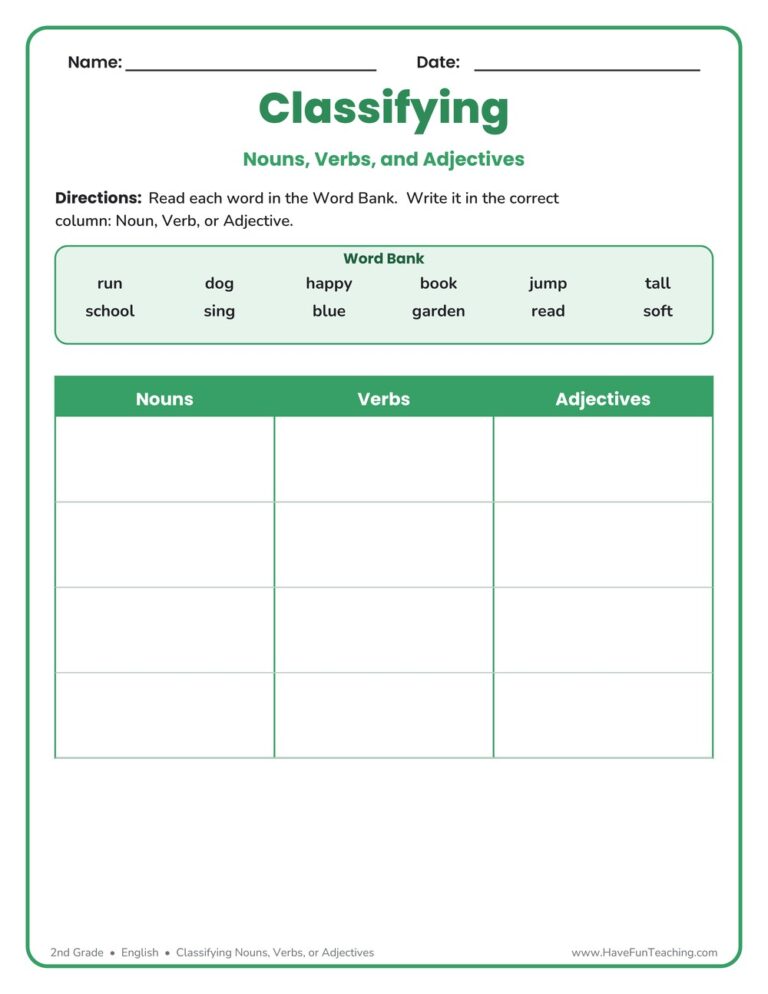
Sort twelve everyday words into nouns, verbs, and adjectives with this Classifying Nouns, Verbs, or Adjectives Worksheet for 2nd grade. Includes a complete answer key for quick, no-prep grammar practice.
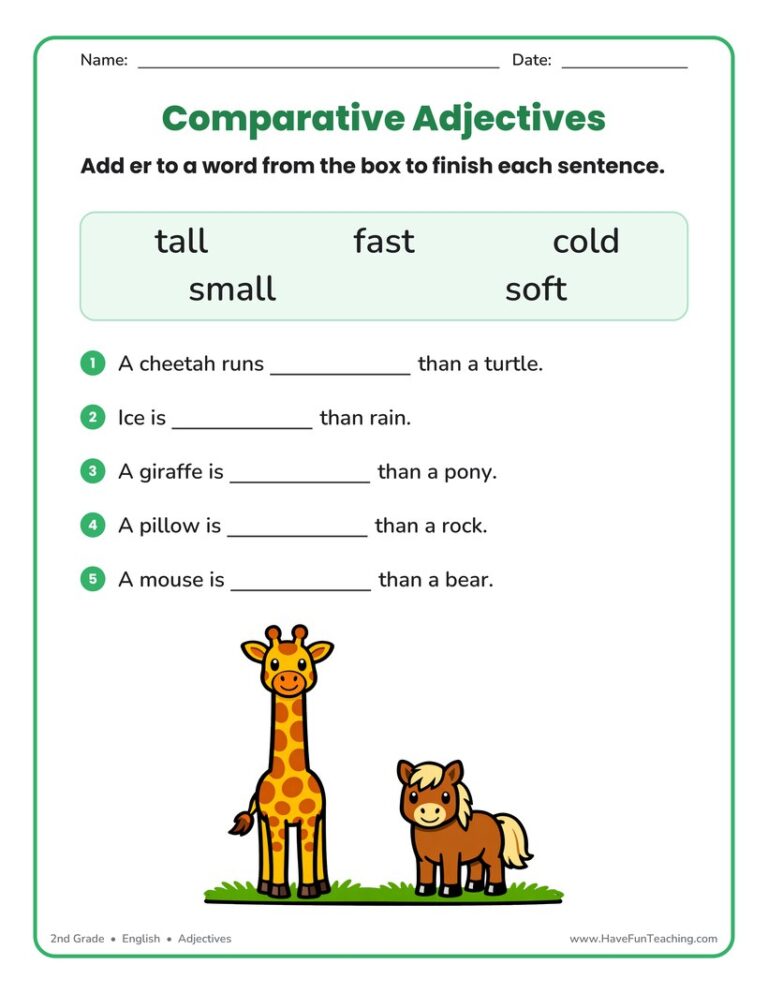
This Comparing Adjectives Fill in Blank Worksheet asks 2nd Grade students to add er to a word from the box and finish five comparing sentences. Answer key included for quick checking.

This experience narrative worksheet guides 2nd graders to plan a true story about where they were, who was there, what they did, and how they felt, then write it with describing words.

This Adding Adjectives Worksheet gives 2nd grade students fun practice finding, choosing, and writing describing words in sentences. An answer key is included, so learning to use adjectives feels clear and rewarding.

This Adjectives Fill in the Blank Worksheet gives 2nd Grade students practice choosing, circling, and writing describing words in real sentences. An answer key is included, so checking work takes seconds.

Using Adjective Flash Cards, students describe pictures using adjectives to build vocabulary and writing skills.

This Adjectives Pictures Worksheet asks 2nd graders to choose the adjective that fits each picture, then write two describing words of their own. Answer key included, so grading takes seconds.

This Adjectives Puppy Story Worksheet has 2nd graders read a short story about a puppy, circle all 8 adjectives, then match each one to the noun it describes. Answer key included for fast, no-prep grammar practice.

This descriptive words worksheet gives 2nd grade students a word box of four adjectives to finish picture sentences, then four more sentences to hunt the adjective in. An answer key is included, so children can check their own work.

Students rewrite sentences by adding a describing word in this Adjectives Sentence Rewriting Worksheet for 2nd Grade. An answer key is included, so checking work takes seconds.

This Adjectives Sort Worksheet asks 2nd graders to file twelve describing words under Feelings, Tastes, or Sizes. Answer key included, so grammar practice is ready in one print with no prep.

This Complete the Sentence with an Adjective Worksheet gives 2nd Grade students five word-box sentences plus four circle-and-underline sentences. An answer key is included, so describing-word practice is ready in minutes.
Reviews
There are no reviews yet