

Identify Simple Machines Worksheet
This Identify Simple Machines Worksheet asks 3rd graders to name the simple machine in six everyday objects, then explain how one of them helps people work. An answer key is included.
$6.97
Want this one free?
Tell us where to send it and it’s yours — no card, no catch.
One free resource per teacher. We’ll also send free teaching ideas each week — unsubscribe anytime.
Free teacher account · no credit card
Membership
Get every game, song, & printable
- Every game, on any device
- 6,500+ resources
- Assign online with HFT Classroom
Then $39.97/year · cancel anytime · See plans
- Instant digital download
- Printable PDF + answer key
- Made by real teachers
Teacher / Family membership
Teaching is easier with every resource
One membership for your whole year: 6,500+ worksheets, games, songs and videos for Preschool–6th, for your classroom or homeschool.
- Unlimited printables & downloads
- Every game, on any device
- Assign online with HFT Classroom
- Cancel anytime
Teacher / Family membership · 3 days free
Yearly
Monthly would be $119.64 a year
$3.33/month
Billed $39.97 once a year
You save $79.67 every year
Start My 3 Free Days$0 today · cancel anytime
Monthly
$9.97/month
Flexible, month to month
Yearly is just $3.33/mo. Switch and save $79.67
Start My 3 Free Days$0 today · cancel anytime
About this resource
Description
Every tool in a garage, a playground or a kitchen is built from just six basic parts: the lever, the pulley, the wheel and axle, the inclined plane, the wedge and the screw. This Identify Simple Machines Worksheet asks third graders to look at a real object and name the simple machine hiding inside it. That is a harder and far more useful task than pairing two blocks of text, because it is exactly what a scientist does — see an everyday thing and recognise the principle at work in it.
The page shows six illustrated objects: a seesaw, a wood screw, a wheelchair ramp, an axe, a doorknob and a well pulley. Under each picture is a long writing line where the student prints the machine’s name. Because no word box is provided, this identify simple machines worksheet asks the child to recall the vocabulary rather than copy it, which is what a unit test will do. A short written response at the bottom of the page then asks the student to choose one machine and explain how it helps people work, so the sheet moves from recognition to reasoning in one step. It fits neatly into a force-and-motion unit, works as a review before an assessment, and suits a 3rd grade simple machines worksheet station or homeschool science lesson. A full answer key is on the last page.
What’s Included
- One printable worksheet page with six illustrated everyday objects
- A full-width writing line under every picture for the machine’s name
- All six simple machines covered exactly once: lever, screw, inclined plane, wedge, wheel and axle, and pulley
- A written-response prompt asking students to explain how one machine helps people work
- Original full-colour artwork drawn just for this sheet
- A complete answer key on the final page
Why This Helps Kids
- It moves science vocabulary out of the glossary and into the real world, so students start spotting machines in the classroom on their own.
- It asks for recall rather than recognition, which is the harder and more durable kind of learning and the kind a test measures.
- The written response builds the habit of explaining thinking in a full sentence, a skill third-grade science standards ask for directly.
Teacher and Parent Ideas
Before handing out the page, hold up a real object from the room — a pair of scissors, a stapler, a doorstop — and ask which simple machine it uses. After the page is finished, send students on a five-minute hunt around the classroom and have each one report a machine they found and the job it does. Pair the sheet with a quick demonstration: prop a board against a stack of books and let students feel the difference between lifting a load straight up and sliding it up the slope. At home, a walk through the kitchen or the garage turns the same page into a scavenger hunt, and the answer key means a parent does not need a science background to check the work.
Related Resources
What teachers say
Reviews
Write a review, earn store credit
Get 25¢ in credit for every approved review of a resource you’ve downloaded, played or purchased — up to 15 a month. Credit applies automatically to your membership payments, so your reviews can help pay for your membership.
Honest reviews only — any star rating earns the same. Program rules
Log in to write a review and earn store credit.
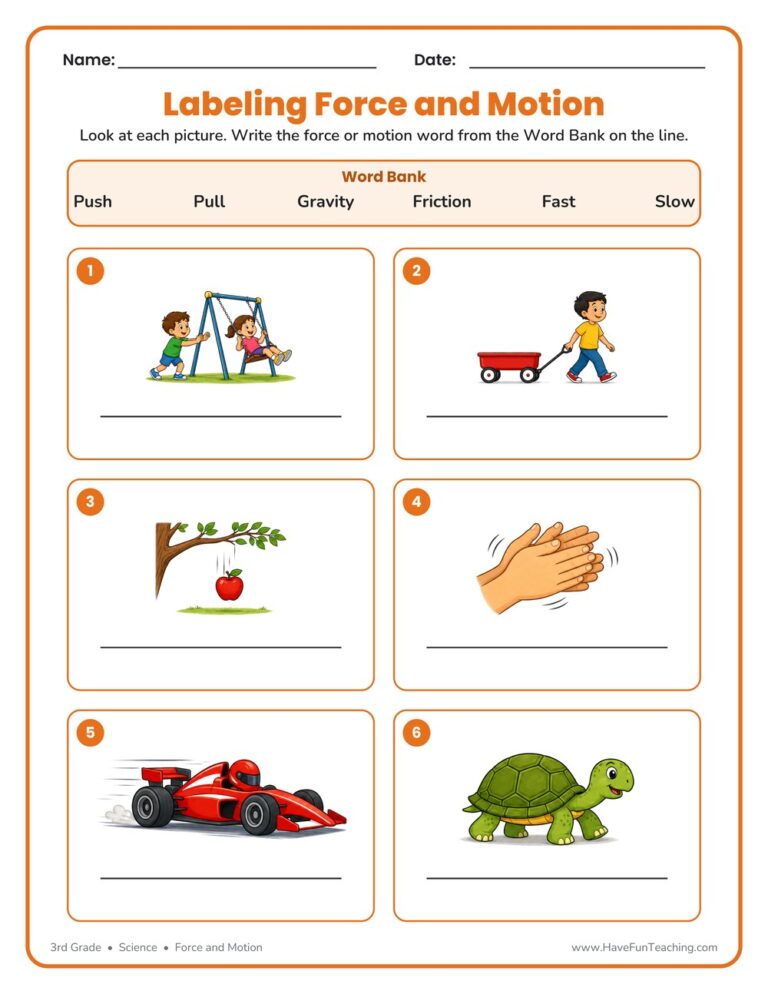
The Labeling Force and Motion Worksheet has 3rd graders label six pictures with push, pull, gravity, friction, fast, and slow from a word bank. Includes an answer key for easy, no-prep science practice.

This simple machines fill in the blanks worksheet has 3rd graders name the lever, pulley, wedge, screw, inclined plane, and wheel and axle from real-life clues, then explain how two of them make work easier. Answer key included.

This man and fuel powered worksheet asks 3rd graders to sort eight machines into people powered and fuel powered columns, then explain four more in writing. Answer key included for a no prep science lesson.

These simple machines flash cards help 1st-3rd grade students learn the six simple machines with diagram cards and everyday object cards. Answer key included.
This robot cut outs worksheet gives 3rd grade students four robots to fill with ideas for helpful robot jobs, then color and cut out, building a bright technology bulletin board the whole class can enjoy.

Simple and compound machines flash cards for 2nd to 4th grade: 16 fold-over picture cards, a practice page and an answer key included, so students learn to spot the simple machines inside everyday tools.
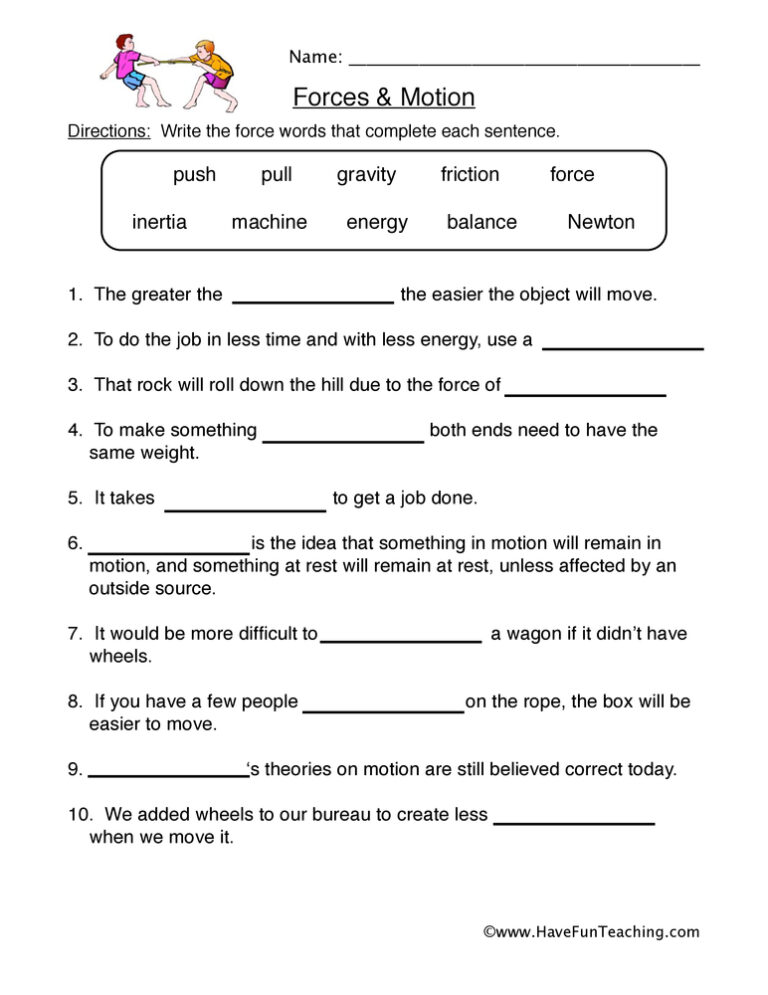
A 3rd grade forces motion worksheet where students use a word bank to complete eight sentences about force, push, pull, gravity, friction, motion, speed, and magnets. Includes an answer key for easy, no-prep science practice.
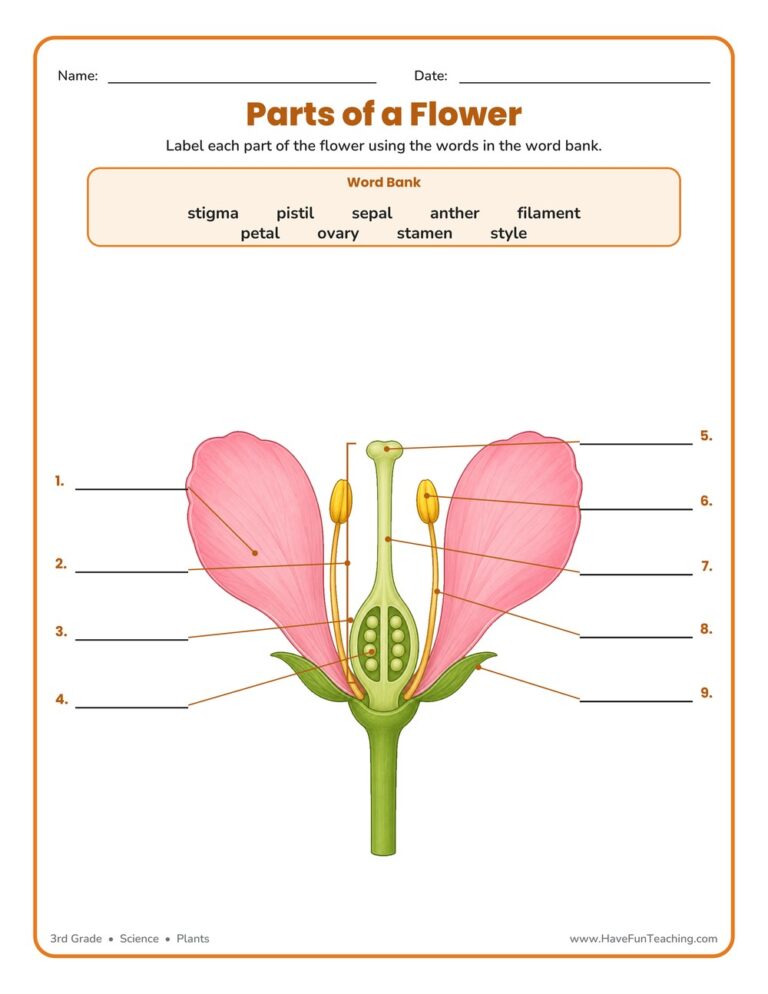
A third grade flower parts of a plant worksheet where students label the nine parts of a flower — petal, sepal, stamen, pistil, and more — using a word bank. Includes a complete answer key for quick, no-prep life science practice.
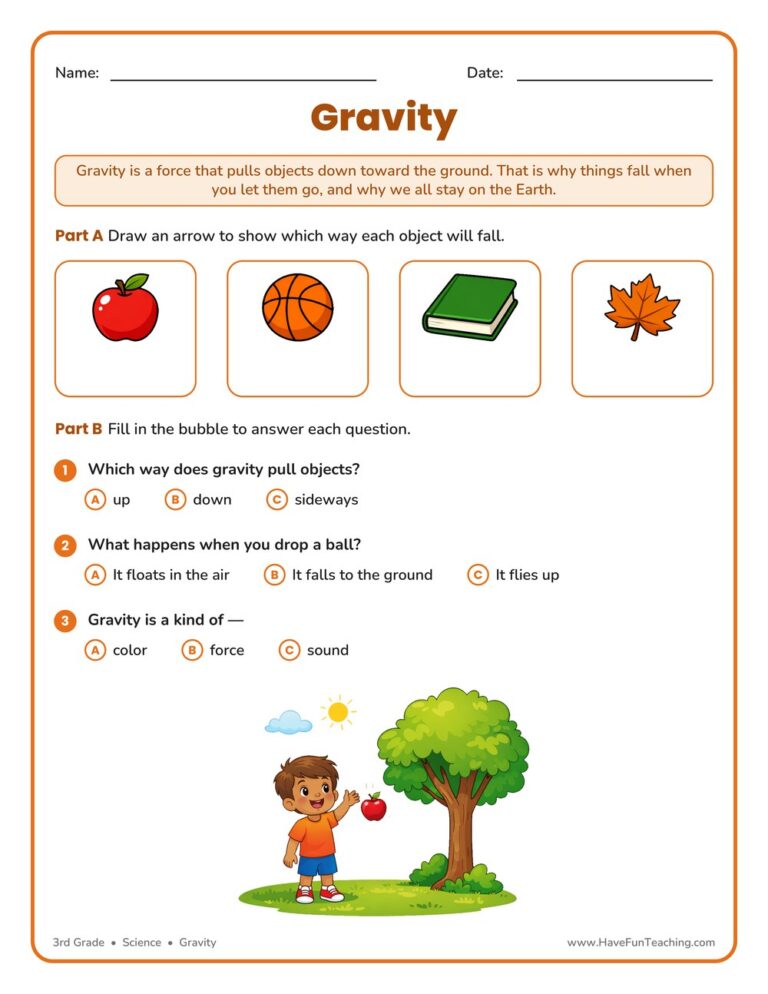
This falling gravity worksheet helps 3rd graders show which way objects fall and explain how gravity pulls things down. Answer key included — a quick, no-prep way to practice force and motion at home or in class.

The Seasons Song by Have Fun Teaching is perfect for teaching and learning all about the seasons of the year. This is a fun way for kids to learn the seasons. With this seasons song, your kids can learn about Spring, Summer, Fall, and Winter. While listening to the Seasons…

While watching the Water Cycle Song (Animated Music Video), students learn about the process of the water cycle by listening to the repetitive lyrics loaded with key vocabulary.

While watching the Planets Song (Animated Music Video), students learn about the order of planets in our solar system as well as cool facts about each planet.




Reviews
There are no reviews yet