Skip to content
Start My 3 Free Days $0 today · cancel anytime

2nd Grade Math Common Core Lessons

30 2nd grade math Common Core Lessons, covering addition, subtraction, measurement, plus 16 more topics. How teachers use these

2nd Grade Math Common Core Lessons

30 2nd grade math Common Core Lessons, covering addition, subtraction, measurement, plus 16 more topics. How teachers use these

Common Core Lesson
Common Core Lesson2nd Grade2.OA.1 Second Grade Common Core Lesson

In this 2.OA.1 Second Grade Common Core Lesson, students add and subtract within 100 to solve one and two step word problems using different strategies.

Common Core Lesson
Common Core Lesson2nd GradeCommon Core Unit Lesson Plan Template

With our Common Core Unit Lesson Plan Template, you can develop your monthly lessons across a specific unit. First, you will pick the theme of your unit.

Common Core Lesson
Common Core Lesson2nd Grade2.OA.2 Second Grade Common Core Lesson

In this 2.OA.2 Second Grade Common Core Lesson, students practice adding and subtracting within 20 and know all sums from memory as quickly as possible!

Common Core Lesson
Common Core Lesson2nd Grade2.NBT.4 Second Grade Common Core Lesson

In this 2.NBT.4 Second Grade Common Core Lesson, students compare two three-digit numbers based on place value using >, =, and < symbols.

Common Core Lesson
Common Core Lesson2nd Grade2.NBT.7 Second Grade Common Core Lesson

In this 2.NBT.7 Second Grade Common Core Lesson students fluently add and subtract within 100o using multiple strategies.

Common Core Lesson
Common Core Lesson2nd Grade2.OA.3 Second Grade Common Core Lesson

In this 2.OA.3 Second Grade Common Core Lesson, students determine whether a group of objects (up to 20) has an odd or even number of members.

Common Core Lesson
Common Core Lesson2nd Grade2.OA.4 Second Grade Common Core Lesson

In this 2.OA.4 Second Grade Common Core lesson, students use addition to find the total number of objects arranged in arrays with up to 5 rows and columns.

Common Core Lesson
Common Core Lesson2nd Grade2.NBT.8 Second Grade Common Core Lesson

In this 2.NBT.8 Second Grade Common Core Lesson, students mentally add and subtract 10 or 100 from a given number 100–900.

Common Core Lesson
Common Core Lesson2nd GradeCommon Core Daily Lesson Plan Template

With our Common Core Daily Lesson Plan Template, you will develop an Objective based on a Common Core Standard. Next, you will use the subject column

Common Core Lesson
Common Core Lesson2nd GradeCommon Core Lesson Plan Template

With our Common Core Lesson Plan Template, you can develop your weekly lessons across multiple subjects. First, you will date your Lesson Plan and label

Common Core Lesson
Common Core Lesson2nd GradeCommon Core Monthly Lesson Plan Template

With our Common Core Monthly Lesson Plan Template, you can develop your monthly lessons across multiple subjects. First, you will date your Lesson Plan and

Common Core Lesson
Common Core Lesson2nd Grade2.MD.6 Second Grade Common Core Lesson

In this 2.MD.6 Second Grade Common Core lesson, students will add and subtract within 100 on a number line.

Common Core Lesson
Common Core Lesson2nd Grade2.MD.8 Second Grade Common Core Lesson

In this 2.MD.8 Second Grade Common Core Lesson, students solve word problems involving dollar bills, quarters, dimes, nickels, and pennies, using $ and ¢ symbols appropriately.

Common Core Lesson
Common Core Lesson2nd Grade2.NBT.1 Second Grade Common Core Lesson

In this 2.NBT.1 Second Grade Common Core Lesson, students understand that the three digits of a three-digit number represent amounts of hundreds, tens, and ones.

Common Core Lesson
Common Core Lesson2nd Grade2.NBT.5 Second Grade Common Core Lesson

In this 2.NBT.5 Second Grade Common Core lesson, students fluently add and subtract within 100 using multiple strategies.

Common Core Lesson
Common Core Lesson2nd Grade2.NBT.6 Second Grade Common Core Lesson

This 2.NBT.6 Second Grade Common Core Lesson includes 2.NBT.6 Worksheets, 2.NBT.6 Activities, 2.NBT.6 Assessment, and 2.NBT.6 Poster

Common Core Lesson
Common Core Lesson2nd Grade2.G.1 Second Grade Common Core Lesson

In this 2.G.1 Second Grade Common Core Lesson, students will recognize and draw shapes having specific attributes such as given number of angles or sides.

Common Core Lesson
Common Core Lesson2nd Grade2.MD.2 Second Grade Common Core Lesson

This 2.MD.2 Second Grade Common Core Lesson includes 2.MD.2 Worksheets, 2.MD.2 Activities, 2.MD.2 Assessment, and 2.MD.2 Poster.

Common Core Lesson
Common Core Lesson2nd Grade2.MD.3 Second Grade Common Core Lesson

In this 2.MD.3 Second Grade Common Core Lesson, students estimate and then measure lengths using units of inches, feet, centimeters, and meters.

Common Core Lesson
Common Core Lesson2nd Grade2.MD.4 Second Grade Common Core Lesson

In this 2.MD.4 Second Grade Common Core Lesson, students willmeasure to determine how much longer one object is than another.

From our teachers' playbook

Big numbers, bigger brains

What do 2nd graders learn in math?

Second grade math is all about growing numbers. Kids learn place value to 1,000, skip count by 5s, 10s and 100s, and add and subtract within 100 with regrouping, like 47 + 36 = 83. By the end of the year they should know addition and subtraction facts within 20 by memory. They also count money, tell time to the nearest five minutes, measure in inches and centimeters, read bar graphs and picture graphs, sort odd and even numbers, and build arrays like 3 rows of 4 = 12 that get them ready for multiplication.

Our go-to moves for 2nd grade math

Second graders learn a lot in one year. These three moves work for almost every topic on the list.

Blocks before borrowing

Before kids write a single regrouping problem, have them solve it with printable base ten blocks. For 52 minus 17, they must break a rod into ten ones to take away 7. When they see the trade, the written steps finally make sense.

Why it works: the U.S. Department of Education's guide for teaching elementary math recommends moving from hands-on objects to drawings to numbers.
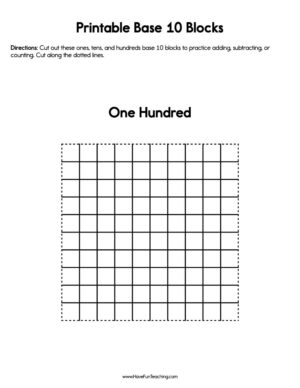
Printable Base 10 BlocksTry it withPrintable Base 10 BlocksActivitiesOpen it →
Count it to music

Skip counting songs are the quickest way to lock in 5s and 10s, and kids use them later for money and time. Play one during morning meeting and have kids clap on each number. Telling time by 5s gets much easier when the song is already in their heads.

Why it works: words set to a repeating melody are easier to recall than the same words spoken (Wallace, 1994).

Counting By Fives Song (Original Music Video)Try it withCounting By Fives Song (Original Music Video)SongsOpen it →

Mix it up on Fridays

Once a week, give a short mixed review: one place value question, one regrouping problem, one money question and one word problem. Mixing topics helps kids figure out which strategy to use, not just repeat the one from today.

Why it works: shuffled practice teaches kids to choose the right strategy, not just repeat one, and it improved test scores in research (Rohrer and Taylor, 2007).

Addition and Subtraction Word Problems WorksheetTry it withAddition and Subtraction Word Problems WorksheetWorksheetsOpen it →

2nd grade math questions from parents

What math should a 2nd grader know?

By the end of 2nd grade, kids should add and subtract within 100 with regrouping, know facts within 20, understand place value to 1,000, tell time to five minutes, and count money. They also measure lengths and read simple graphs.

What is regrouping in 2nd grade math?

It is trading ten ones for one ten or one ten for ten ones when adding or subtracting. Some families know it as carrying and borrowing.

Do 2nd graders learn multiplication?

Not formally, but they build the foundation. They skip count, use repeated addition and make arrays, which prepares them for multiplication in 3rd grade.

How can I help my child with 2nd grade math at home?

Count coins together, read an analog clock, and play quick dice addition games. Short daily practice does more than one long homework session on the weekend.

Why is 2nd grade math harder?

Kids move from small numbers to three-digit numbers and from counting to regrouping. That jump takes time, so hands-on models and steady practice are a big help.