Skip to content
Start My 3 Free Days $0 today · cancel anytime

Place Value Activities

11 place value activities. Teacher favorites: Printable Base 10 Blocks and Finding 10 More 10 Less Activity. How teachers use these

Place Value Activities

11 place value activities. Teacher favorites: Printable Base 10 Blocks and Finding 10 More 10 Less Activity. How teachers use these

Activity
Activity2nd GradePrintable Base 10 Blocks

This Printable Base 10 Blocks worksheet gives 2nd graders cut-out hundreds, tens, and ones blocks to build numbers by hand — a no-prep, hands-on way to make place value, counting, and addition click.

Activity
Activity1st GradeFinding 10 More 10 Less Activity

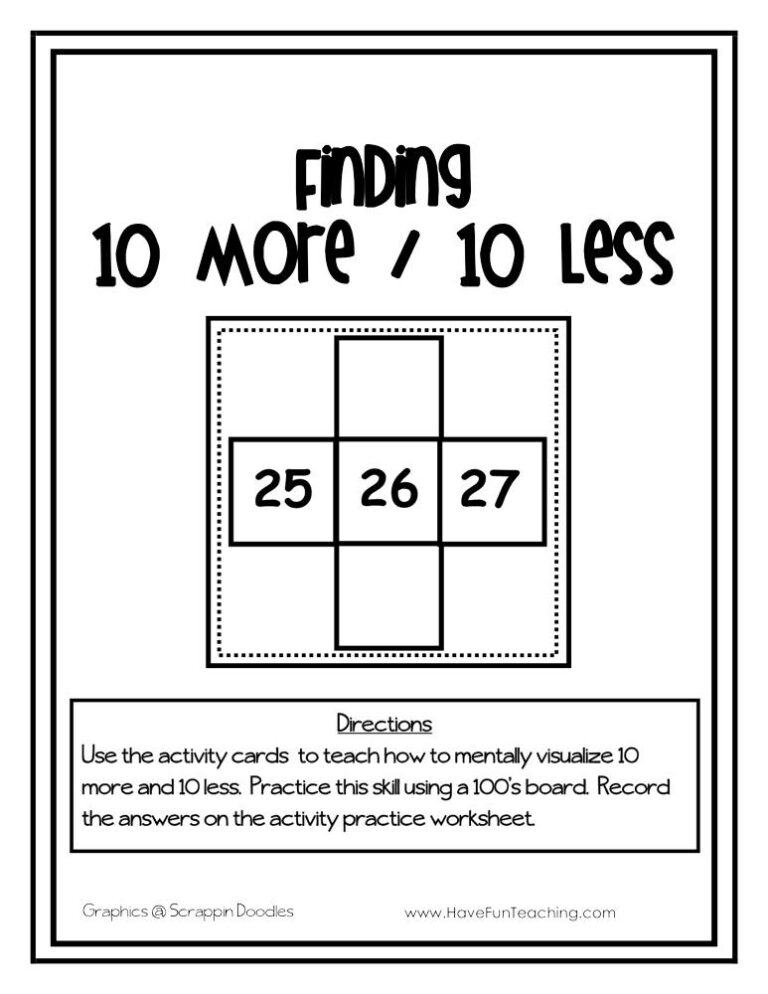
This finding 10 more 10 less activity helps 1st and 2nd grade children use a hundred chart to find 10 more and 10 less. Practice page and answer key included.

Activity
ActivityKindergartenRainbow Place Value Activity

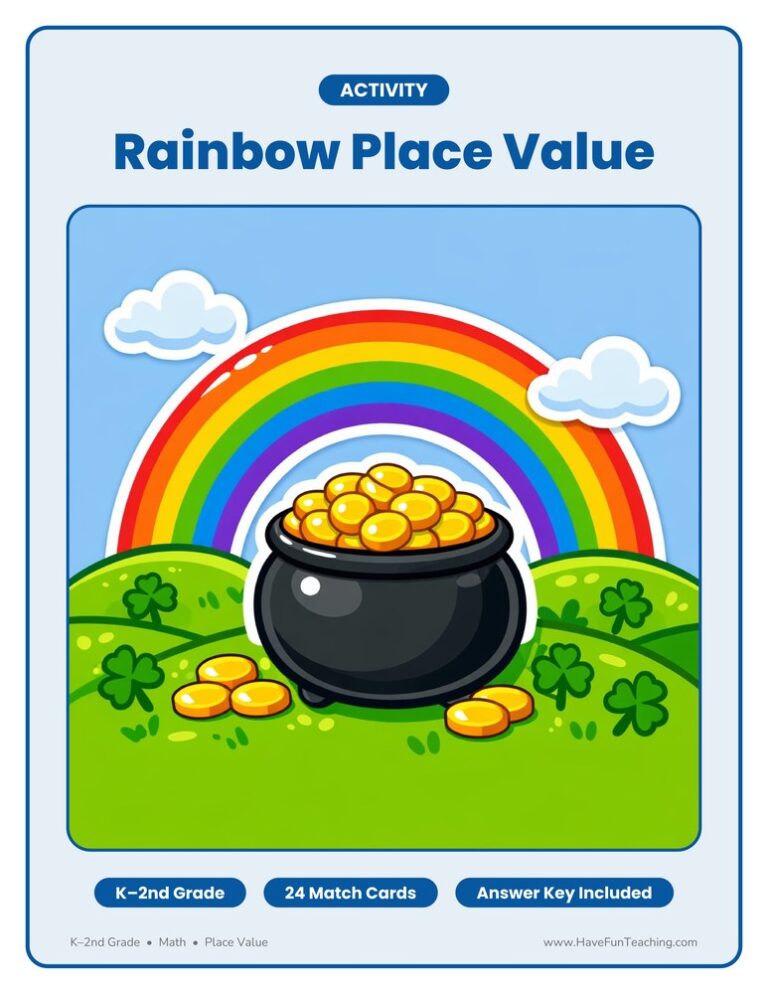
This rainbow place value activity has children match pots of gold to tens and ones cards. Made for Kindergarten to 2nd Grade, with a practice page and answer key included.

Activity
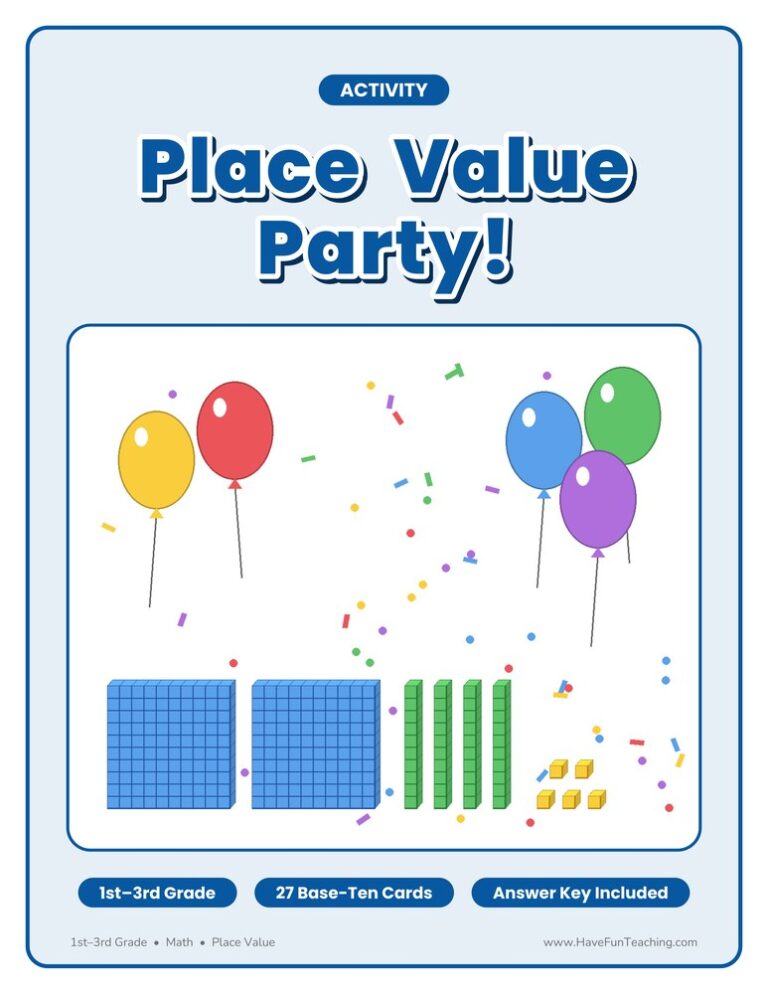
Activity1st GradePlace Value Party Place Value Activity

The Place Value Party Place Value Activity lets 1st to 3rd Grade students spin numbers, build them with base-ten cards and write expanded form. Answer key included.

Activity
Activity2nd GradeSt. Patrick's Day Place Values Activity

This St. Patrick's Day place values activity has 2nd-3rd grade students match three-digit numbers to expanded form cards. Answer key included, so checking is quick and easy.

Activity
Activity4th GradePBJ Place Value Activity

Match standard, word and expanded form with this PBJ place value activity for 4th grade: 30 sandwich, peanut butter and jelly cards, a recording sheet and practice, answer key included.

Activity
Activity2nd GradePopcorn Mental Math Activity

This popcorn mental math activity lets 2nd and 3rd grade students add and subtract 10 and 100 in their heads with a fun partner card game, recording sheet, and practice page. Answer key included.

Activity
Activity3rd Grade3.NBT.1 Common Core Activity

This 3.NBT.1 Common Core Activity lets 3rd Grade students round numbers to the nearest 10 or 100 by sorting 24 cards into Round Up and Round Down, with an answer key included.

Activity
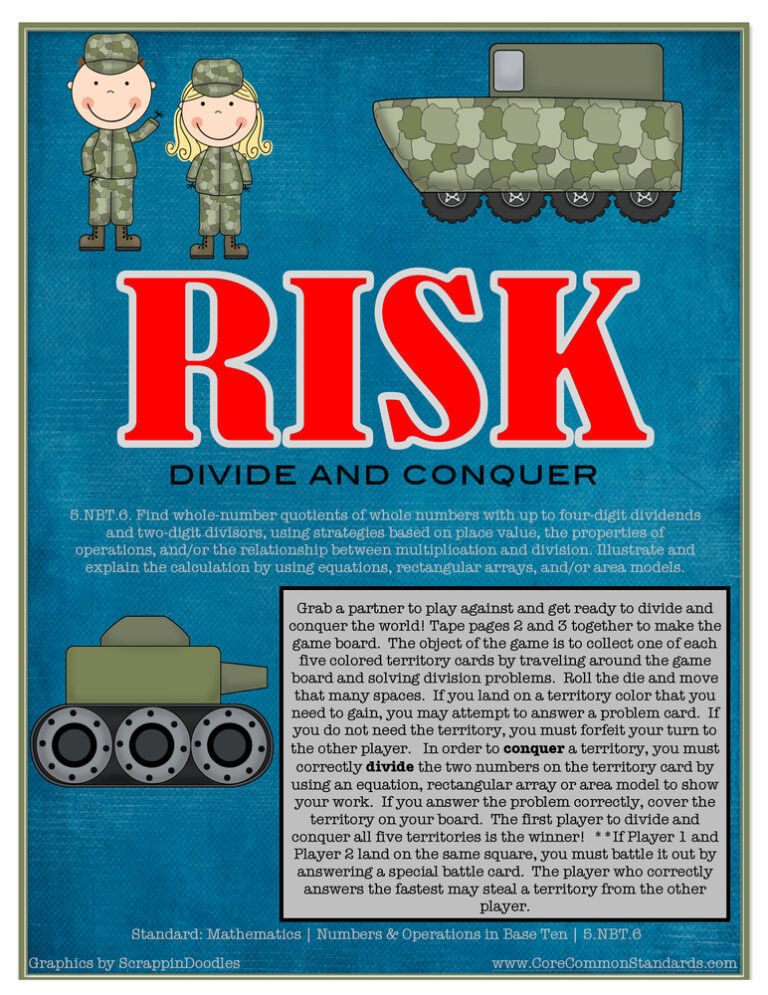
Activity5th Grade5.NBT.6 Common Core Activity

In this 5.NBT.6 Common Core Activity, students find whole-number quotients of whole numbers with up to four-digit dividendsand two-digit divisors.

Activity
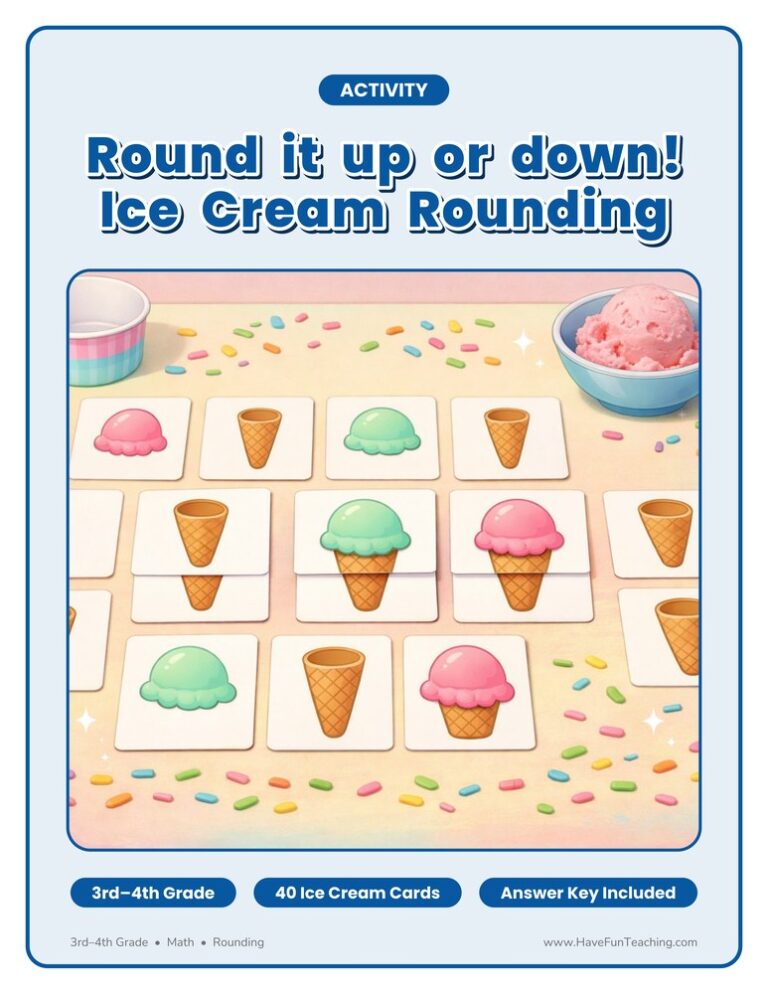
Activity3rd GradeRound it Up or Down Ice Cream Activity

This round it up or down ice cream activity has 3rd and 4th grade students match number scoops to cones by rounding to the nearest ten and hundred. Answer key included for quick checking.

Activity
Activity3rd GradeScooping Up Hundreds Rounding Activity

In this Scooping Up Hundreds Rounding Activity, students use place value understanding to round whole numbers to the nearest 100.

From our teachers' playbook

Every digit has a home address

What do kids learn about place value?

Place value is the idea that a digit is worth more or less depending on where it sits. It grows with kids: first graders bundle ones into tens, 2nd graders work with hundreds, 3rd and 4th graders stretch to thousands and beyond, and 5th graders slide past the decimal point into tenths and hundredths. The same rule runs the whole way: each place is ten times the place to its right. So in 4,527 the 5 is worth 500, and in 0.5 it is worth just five tenths. When kids see that pattern, regrouping, rounding and decimals stop feeling like three separate topics.

Teaching moves that make place value make sense

Place value is abstract until kids can see and touch it. These three moves take them from blocks to digits without losing anybody along the way.

Trade ten for one

Give partners a pile of base ten blocks and a trading mat. Every time they collect ten unit cubes, they must trade them in for one rod, and ten rods for a flat. Saying "I traded ten ones for one ten!" out loud is the exact thinking kids need later for regrouping.

Why it works: going from real objects to pictures to symbols is a core recommendation of the U.S. Department of Education's elementary math guide.

Printable Base 10 BlocksTry it withPrintable Base 10 BlocksActivitiesOpen it →
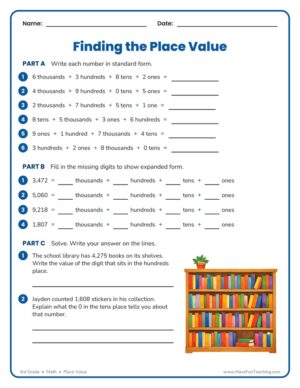
Chart it before you write it

Keep a place value chart on every desk for the whole unit. Kids drop each digit into its column before they say the number, so a zero in the tens place never goes missing. Once they can read 3,048 off the chart, take the chart away and see if they can still do it.

Why it works: pairing a picture with each word gives kids two ways to remember it, a well-tested principle of how people learn (Mayer, 2009).

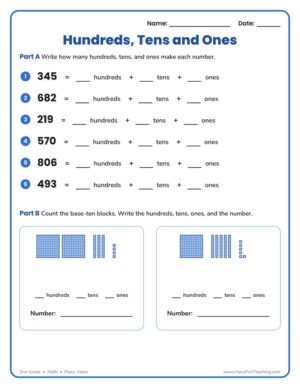
Place Value Thousands, Hundreds, Tens, Ones WorksheetTry it withPlace Value Thousands, Hundreds, Tens, Ones WorksheetWorksheetsOpen it →

What is it worth?

Start math with a two-minute warm-up: write one big number on the board and point to a digit. Kids write its value on a whiteboard and flash it up. Mix in tricky ones like the 0 in 506, because that is where the mistakes hide.

Why it works: researchers who compared ten study methods found practice testing is one of the two that work best (Dunlosky and colleagues, 2013).

Determining Place Value GameTry it withDetermining Place Value GameGamesOpen it →

Place value questions we hear a lot

What grade do kids learn place value?

It starts in kindergarten and 1st grade with tens and ones, then grows every year. Second grade adds hundreds, 4th grade works with numbers into the millions, and 5th grade extends place value to decimals.

Why do kids struggle with place value?

Usually because they learned digits before they understood what a ten really is. Zeros cause the most trouble, as in writing 4,007 as 47. Going back to blocks and a place value chart fixes most of it fast.

What are base ten blocks?

They are models of place value: a small cube is one, a rod is ten, a flat is one hundred and a big cube is one thousand. Printable paper blocks work just as well as plastic ones for building and drawing numbers.

How does place value help with addition and subtraction?

Regrouping is place value in action. When kids know that ten ones make a ten, "carrying" and "borrowing" become trading, and the steps finally make sense instead of feeling like magic.

How is place value used with decimals?

The same pattern keeps going to the right of the decimal point. Each place is one tenth of the place before it, so 0.3 is three tenths and 0.03 is three hundredths.