
Skip to content
Start My 3 Free Days $0 today · cancel anytime

Clocks Resources

41 clocks resources: 26 worksheets, 14 activities, 1 assessment and more. How teachers use these

Clocks Resources

41 clocks resources: 26 worksheets, 14 activities, 1 assessment and more. How teachers use these

Worksheet
Worksheet2nd GradeWrite the Time Worksheet

This Write the Time Worksheet has 2nd graders read six analog clocks to the nearest five minutes, then draw the hands for two more. Answer key included, so clock practice is ready in one print.

Worksheet
Worksheet2nd GradeCount by Fives on a Clock Worksheet

This count by fives on a clock worksheet has 2nd graders skip count around a clock face, then read three clocks to the nearest five minutes. Answer key included, so telling time practice takes no prep.

Worksheet
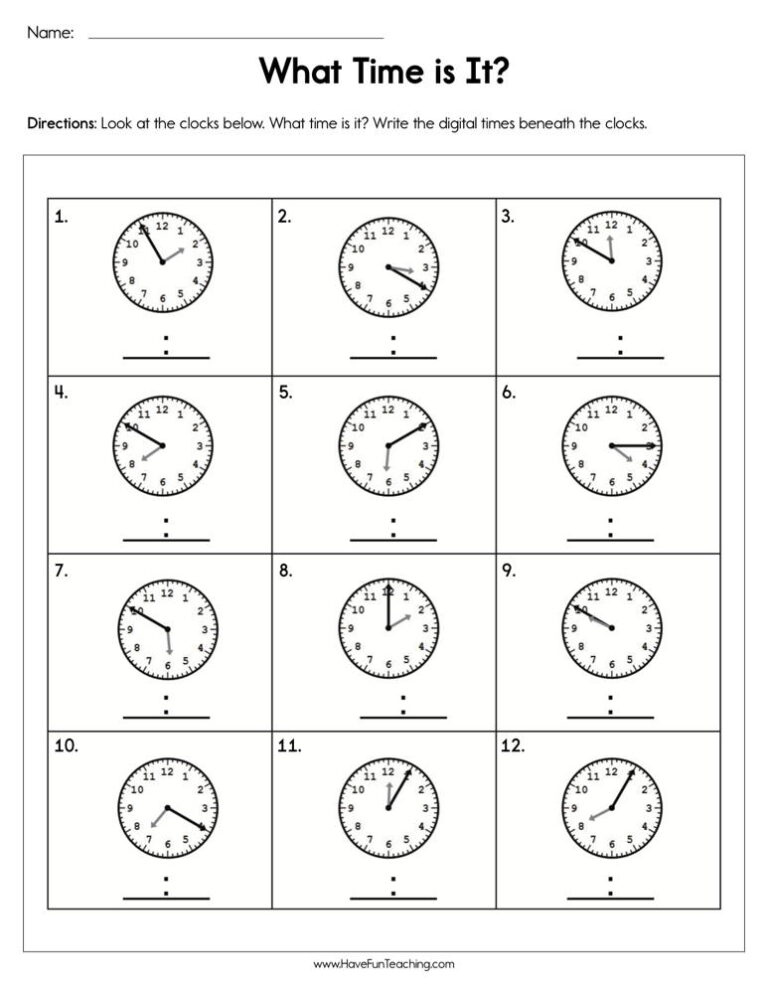
Worksheet1st GradeWhat Time Is It Worksheet

A What Time Is It worksheet where 1st graders read six analog clocks and write the digital time to the hour and half hour. Includes a complete answer key — perfect for quick, no-prep telling time practice at home or school.

Assessment
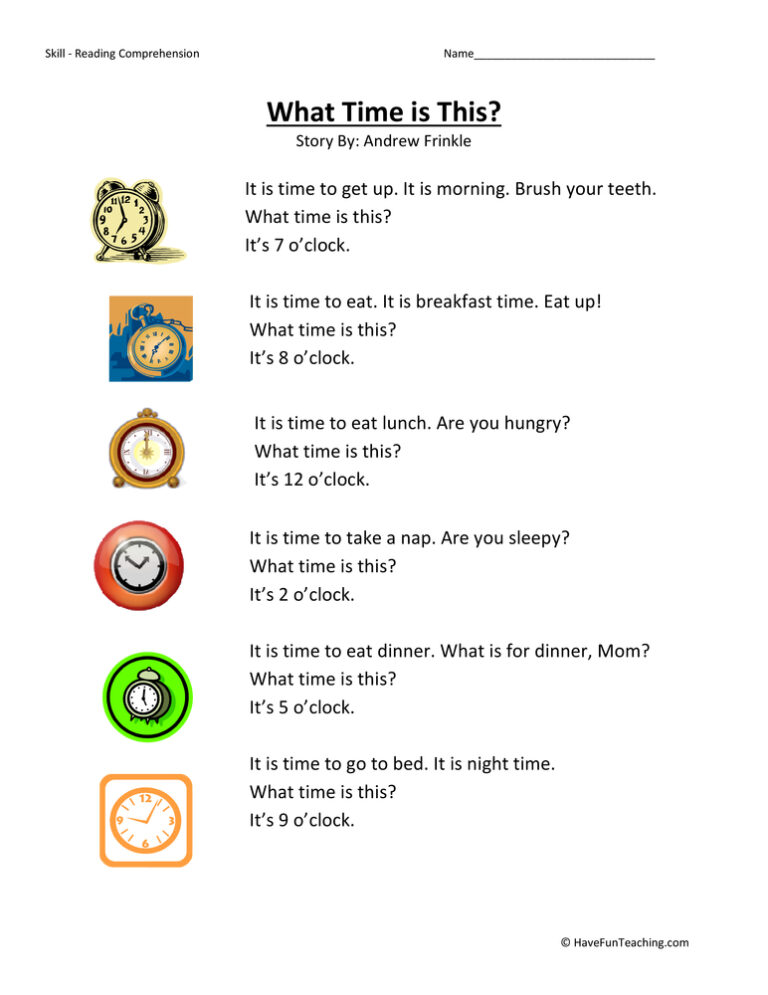
Assessment1st GradeWhat Time is This Reading Comprehension Worksheet

This What Time is This Reading Comprehension Worksheet gives 1st graders a short story about a boy's day and five questions about the o'clock times inside it. Answer key included for quick, no-prep practice.

Worksheet
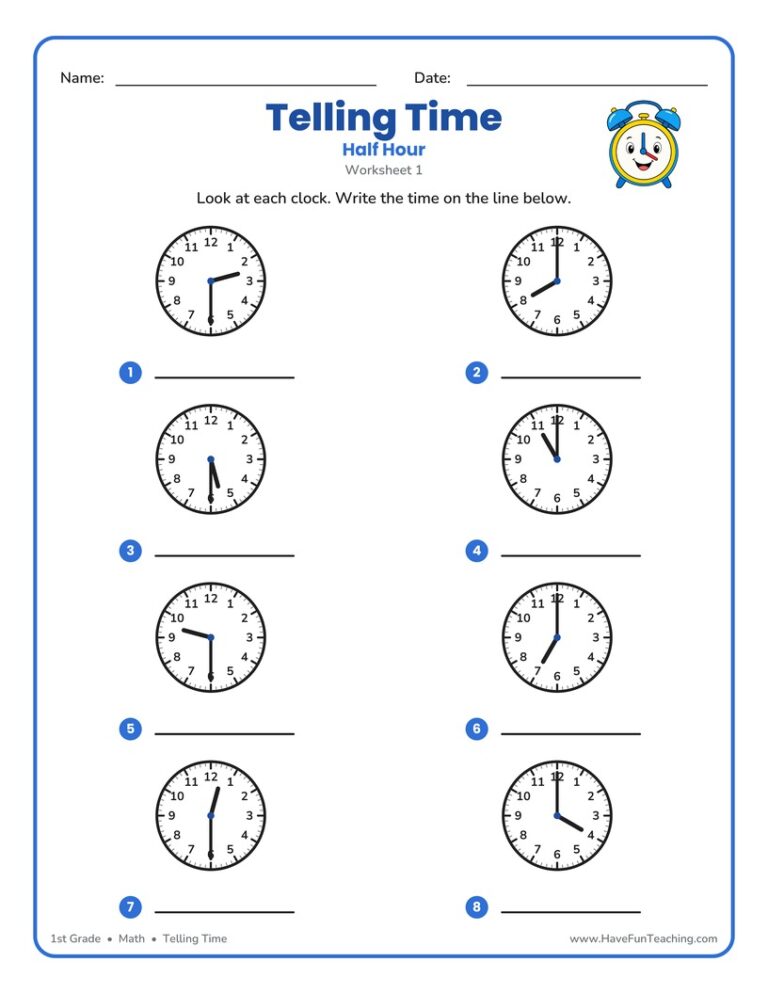
Worksheet1st GradeTelling Time To The Half Hour Worksheet

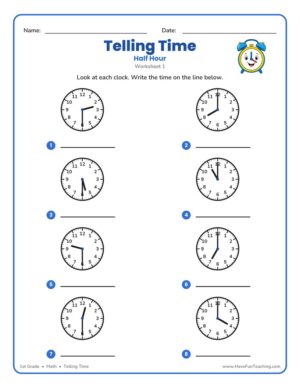
A Telling Time To The Half Hour Worksheet where first graders read eight analog clocks and write each time. Includes an answer key—perfect for quick, no-prep clock practice at home or school.

Worksheet
Worksheet3rd GradeElapsed Time Word Problem Solving Worksheet

An elapsed time word problem solving worksheet for 3rd grade, with four analog clocks and three multi-step time problems. Answer key included, so students get fast feedback and real practice reading a real day.

Worksheet
Worksheet2nd GradeShow the Time Worksheet

This Show the Time Worksheet has 2nd graders draw clock hands for six printed times, then write the digital time two clocks already show. Answer key included, so telling time practice needs no prep.

Worksheet
Worksheet1st GradeThe Clock Worksheet

The Clock Worksheet has 1st graders fill in the missing numbers on a big clock face, then read three clocks and write each time. Answer key included, so the dial finally makes sense with zero prep.

Worksheet
Worksheet2nd GradeWhat Is The Time Worksheet

This What Is The Time Worksheet gives 2nd graders six analog clocks to read to the nearest five minutes, plus three a.m./p.m. sentences. An answer key is included, so time practice checks itself in seconds.

Activity
ActivityKindergartenTelling Time Activity

Using this Telling Time Activity, students practice telling time to the hour on an analog clock.

Worksheet
Worksheet3rd GradeSubtracting Time Worksheet

This Subtracting Time Worksheet gives 3rd grade students five elapsed time rows and three word problems to solve. An answer key is included, so children practice borrowing minutes with confidence.

Worksheet
Worksheet2nd GradeShowing the Time on a Clock Worksheet

A showing the time on a clock worksheet where 2nd graders draw the hour and minute hands for six five-minute times, then solve two clue problems. Answer key included for fast, no-prep practice.

Worksheet
Worksheet2nd GradeHow Much Time Passed To The Hour Worksheet

This how much time passed to the hour worksheet gives 2nd graders four pairs of analog clocks plus two word problems to find the hours between a start and an end time. Answer key included for fast, no-prep practice.

Worksheet
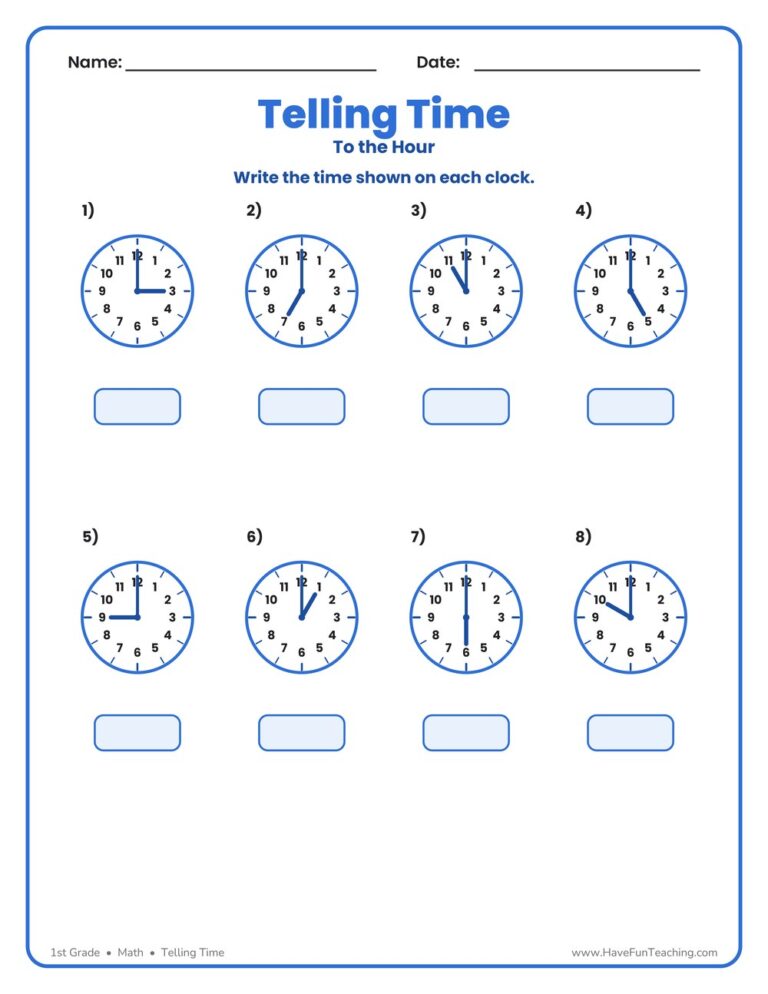
Worksheet1st GradeTelling Time To The Hour Worksheet

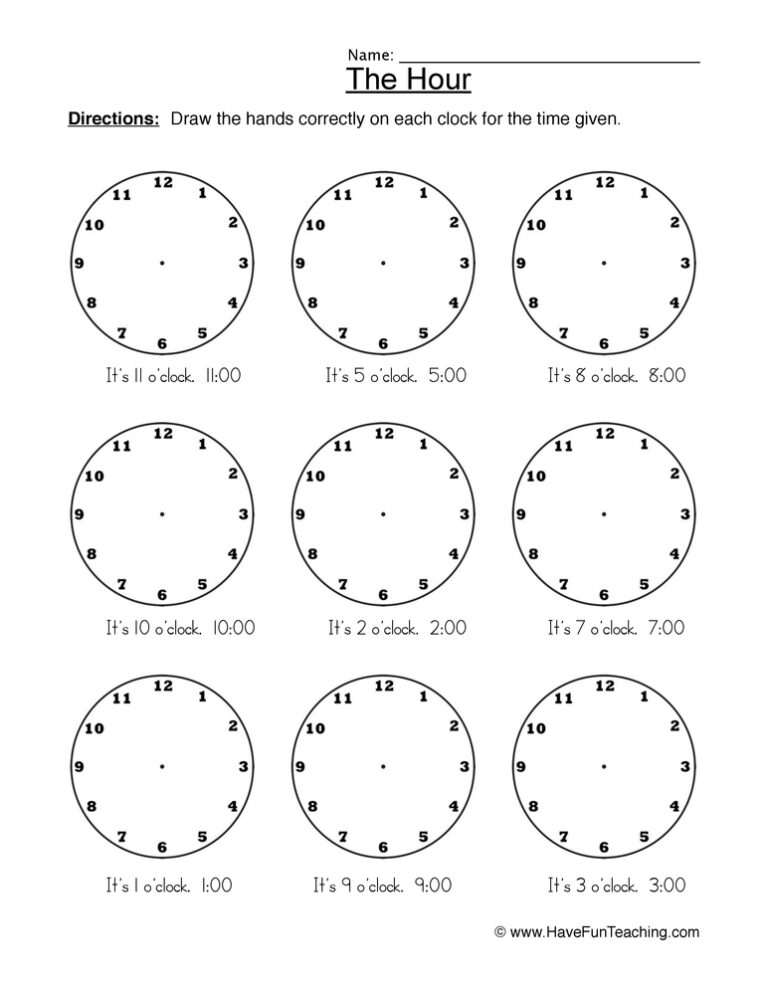
This Telling Time To The Hour Worksheet gives 1st graders eight analog clocks to read and write as digital times. Includes a complete answer key—perfect for quick, no-prep clock practice at home or school.

Worksheet
Worksheet1st GradeShowing Time Worksheet

This Showing Time Worksheet has 1st graders read six analog clocks and draw the hands on three more, all to the hour. A complete answer key is included for fast, no-prep practice.

Worksheet
Worksheet1st GradeTime Telling Worksheet

This time telling worksheet asks 1st grade students to write the time under six clocks set to the hour and half hour, then draw the hands on three more. An answer key is included.

Worksheet
Worksheet1st GradeTime to the Hour Worksheet

This time to the hour worksheet has 1st graders read six analog clocks and then draw the hands on two more. An answer key is included, so whole-hour practice is ready to hand out with no prep.

Worksheet
Worksheet1st GradeIdentifying Times Worksheet

This Identifying Times Worksheet gives 1st Grade students nine analog clocks to read and draw, practicing time to the hour both ways. An answer key is included, so checking the page takes seconds.

Worksheet
Worksheet4th GradeTime Word Problem Solving Worksheet

This time word problem solving worksheet gives 4th grade students six real-life stories about elapsed, start, and end times, plus an answer key to check every step.

Worksheet
Worksheet3rd GradeSubtracting Time Problems Worksheet

This subtracting time problems worksheet helps 3rd grade students work backward from an end time to find when an activity started. An answer key is included for quick, confident checking.

From our teachers' playbook

Tick tock, read the clock!

What do kids learn about clocks?

Reading a clock builds step by step. First graders tell time to the hour and half hour, learning that the short hand shows the hour and the long hand shows the minutes: 3:30 = half past three. Second graders read time to the nearest five minutes by skip counting around the clock and learn a.m. and p.m. Third graders tell time to the minute and solve elapsed time problems, like how long recess lasts. The click moment comes when a child glances at the classroom clock and announces "Ten more minutes until lunch!"

Our favorite ways to teach telling time

Analog clocks can be confusing. These moves break it into easy steps.

Hands-on clocks

Give every child a clock with movable hands. Call out a time and have them show it, then check with a partner. Start with only the hour hand so kids learn to read it first, then add the minute hand.

Why it works: the U.S. Department of Education's guide for teaching elementary math recommends moving from hands-on objects to drawings to numbers.

Telling Time ActivityTry it withTelling Time ActivityActivitiesOpen it →
Hour then half hour

Show clocks at 2:00 and 2:30 side by side and talk about what changed. The minute hand moved halfway around, and the hour hand moved halfway to 3. Noticing the hour hand move is what prevents classic mistakes.

Why it works: pairing a picture with each word gives kids two ways to remember it, a well-tested principle of how people learn (Mayer, 2009).

Telling Time To The Half Hour WorksheetTry it withTelling Time To The Half Hour WorksheetWorksheetsOpen it →

Elapsed time stories

Mix elapsed time word problems into daily practice, using real class times: "Art starts at 10:15 and lasts 45 minutes. When does it end?" Draw a number line timeline to jump by hours and minutes.

Why it works: mixing different kinds of problems in one practice set helped students do far better on a later test (Rohrer and Taylor, 2007).

Elapsed Time Word Problem Solving WorksheetTry it withElapsed Time Word Problem Solving WorksheetWorksheetsOpen it →

Questions parents and teachers ask us

What age do kids learn to tell time?

Most kids learn to tell time to the hour and half hour in 1st grade (around age 6 or 7), to five minutes in 2nd grade, and to the minute in 3rd grade.

How do I teach my child to read a clock?

Start with the hour hand only. Then add the minute hand and practice counting by fives around the clock. Ask "What time is it?" often during the day.

What is elapsed time?

Elapsed time is how much time passes between a start time and an end time. For example, from 2:00 to 2:45 is 45 minutes. Third graders solve elapsed time problems.

Why do kids still need analog clocks?

Analog clocks help kids understand time as a measure that moves, and they connect to fractions like half past and quarter past. They also appear on tests and in many classrooms.

Keep exploring



