Skip to content
Start My 3 Free Days $0 today · cancel anytime

3rd Grade Speaking and Listening Activities

22 3rd grade speaking and listening activities. Teacher favorites: What Does it Mean Literal Non-Literal Language Activity and Let's Talk Classroom Speaking Activity. How teachers use these

3rd Grade Speaking and Listening Activities

22 3rd grade speaking and listening activities. Teacher favorites: What Does it Mean Literal Non-Literal Language Activity and Let's Talk Classroom Speaking Activity. How teachers use these

Activity
Activity3rd GradeWhat Does it Mean Literal Non-Literal Language Activity

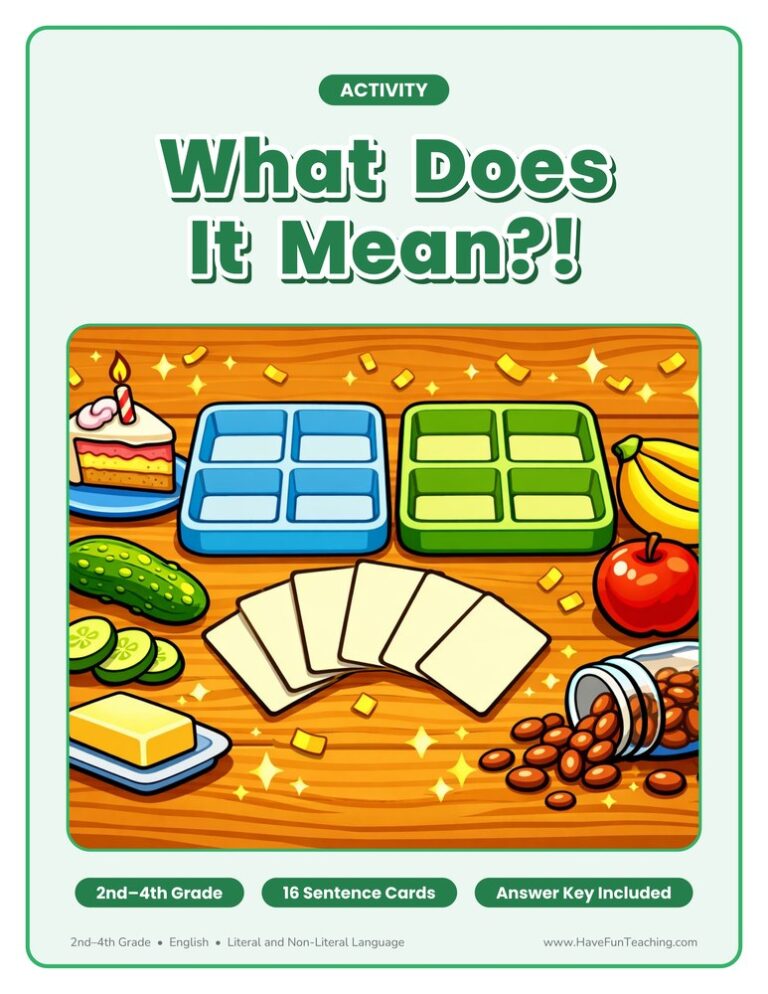
This what does it mean literal non-literal language activity has 2nd to 4th grade students sort 16 food sentence cards and explain idioms. A practice page and answer key are included.

Activity
Activity3rd GradeLet's Talk Classroom Speaking Activity

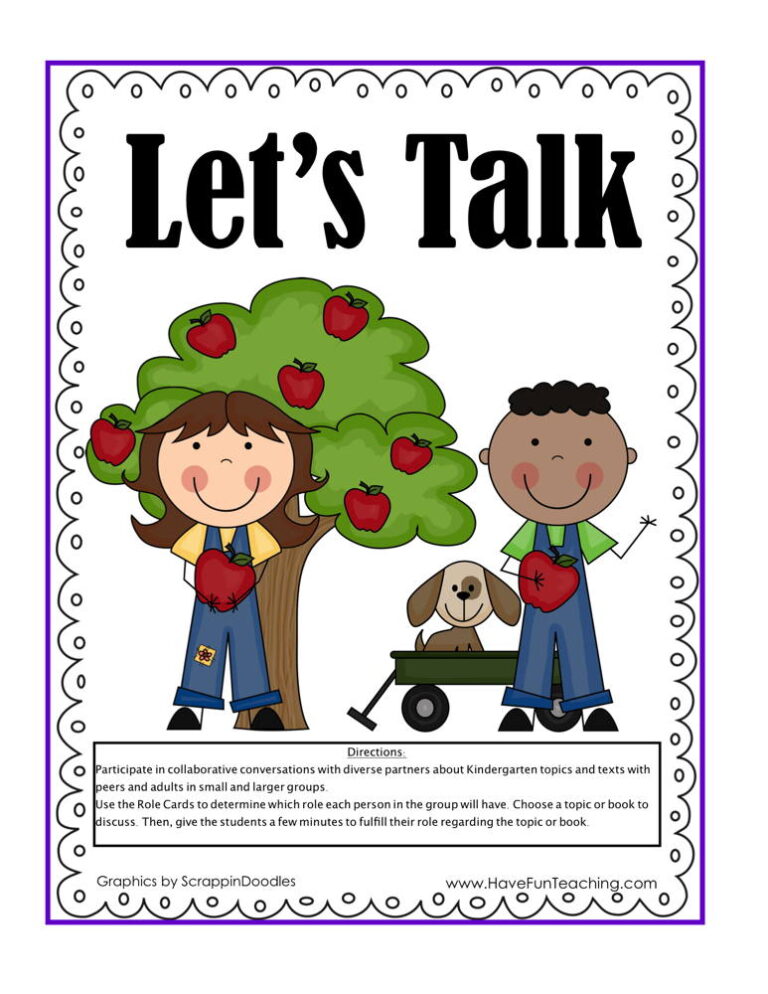
This Let's Talk classroom speaking activity gives kindergarten through 3rd grade students role cards, topic cards and a self-check for small group talks. A practice page and answer key are included.

Activity
Activity3rd GradeFeeling Words Activity

This feeling words activity has 1st to 3rd graders read a story, match clue cards to feeling words, and practice naming how characters feel. An answer key is included.

Activity
Activity3rd GradeTotal Recall Activity

This total recall activity for Kindergarten to 3rd Grade has kids tell about real memories, spin for a question word, and draw and write about one memory.

Activity
Activity3rd Grade5 Minutes of Fame Read Aloud Activity

With this 5 minutes of fame read aloud activity, 1st-3rd Grade students practice and perform short poems with a paper microphone. A practice page and answer key are included.

Activity
Activity3rd GradeWho What When Where Why How Activity

This who what when where why how activity is a newspaper card game for 1st to 3rd grade that builds key detail skills, with a practice page. Answer key included.

Activity
Activity3rd GradeGold Medal Reading Strategies Activity

This gold medal reading strategies activity gives 1st to 3rd grade students a model story and four organizers for story maps, retelling and connections. Answer key included.

Activity
Activity3rd GradeRead it Aloud Activity

This read it aloud activity has 1st-3rd Grade students order Three Little Pigs story cards, then read them aloud with expression. A buddy checklist, practice page and answer key are included.

Activity
Activity3rd GradeAfter Reading Discussion Cards Activity

These after reading discussion cards give kindergarten to 3rd grade readers 24 story questions, a spinner and a book talk page for lively group conversations about any book.

Activity
Activity3rd GradeHelp Me Out Asking Questions Activity

The Help Me Out Asking Questions Activity is a matching game where children pair classroom mix-ups with the clear question that fixes each one. Made for 1st through 3rd grade, with an answer key included.

Activity
Activity3rd GradeDiscussions Preparation Activity

This discussions preparation activity helps 3rd to 5th grade students sort prep notes and plan an opinion, evidence and a question before a class talk. Answer key included.

Activity
Activity3rd GradeFormal or Informal English Activity

This formal or informal English activity has 3rd to 5th grade students sort envelope situation cards by audience and rewrite informal sentences, with an answer key included for quick checking.

Activity
Activity3rd GradeFormal Informal Language Activity

This formal informal language activity has 2nd-4th grade students sort 16 phrase cards by a top hat or ball cap and match pairs. Answer key included.

Activity
Activity3rd GradeReading Questions Camping Activity

Try this reading questions camping activity with 1st to 3rd grade readers. Kids read a camping story and match question cards to answer cards; an answer key is included.

Activity
Activity3rd GradeQuestion Cards for Reading Activity

This question cards for reading activity helps kindergarten through 3rd grade students ask and answer who, what, where, when, why and how questions about any book they read together.

Activity
Activity3rd GradeTell the Group Speaking and Listening Activity

This Tell the Group speaking and listening activity helps K-3rd graders plan a short talk, share details with a group and give kind feedback as listeners. Answer key included.

Activity
Activity3rd GradeNow Presenting! Report on a Topic Activity

This Now Presenting! Report on a Topic activity helps 3rd to 5th Grade students plan and give organized talks with movie ticket prompts and a planner. Answer key included.

Activity
Activity3rd GradeTell Us About It Speaking Activity

This tell us about it speaking activity gives Kindergarten to 3rd Grade children 24 story cards and a spinner so they can practice telling true stories with details to a group.

Activity
Activity3rd GradeDiscussion Guide for Preparation and Reflection

Students plan ideas, take a discussion role and reflect on how the talk went with this 3rd to 5th grade speaking and listening activity. Includes role cards, a rules poster and planning pages.

Activity
Activity3rd GradeLet's Chat Discussion Starter Activity

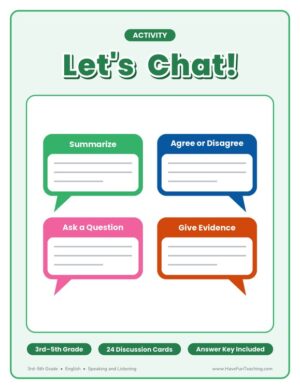
This let's chat discussion starter activity gives 3rd to 5th Grade students 24 sentence starter cards, bookmarks and a speaker notes sheet, with a practice page and answer key included.

From our teachers' playbook

Big voices, better listeners

What do 3rd graders learn about speaking and listening?

Third grade is when classroom talk grows up. Kids learn to come to a discussion prepared, wait their turn, and build on what a classmate just said instead of starting a brand new topic. They practice asking real questions ("Can you say more about that?"), retelling the main ideas of something read aloud, and speaking in complete sentences at an understandable pace. They also start to notice that we talk differently to the principal than to a best friend. The click moment? When a student says "I agree with Maya, and I want to add..." all on their own.

Our favorite ways to build speaking and listening skills

Good talk is taught, not caught. These moves give every child a script, a role and a reason to listen.

Model the discussion first

Before kids discuss, we fishbowl it. Four students talk in the middle while everyone else watches for one thing, like "Who built on someone else's idea?" Then we name what we saw and post the sentence stems on the board.

Why it works: showing first, practicing together, then letting kids try alone is the "gradual release" model teachers have relied on for decades (Pearson and Gallagher, 1983).

SL.3.1 Third Grade Common Core LessonTry it withSL.3.1 Third Grade Common Core LessonCommon Core LessonsOpen it →

Give everyone a job

Hand out roles before a small-group talk: starter, questioner, connector and summarizer. Rotate them each day so the quiet kids get the floor and the chatty kids practice listening. Groups that have jobs stay on topic far longer.

Why it works: kids understand an idea best when they touch it, then draw it, then write it, the order the U.S. Department of Education recommends for elementary math.

Roles of Conversation ActivityTry it withRoles of Conversation ActivityActivitiesOpen it →

Formal or informal?

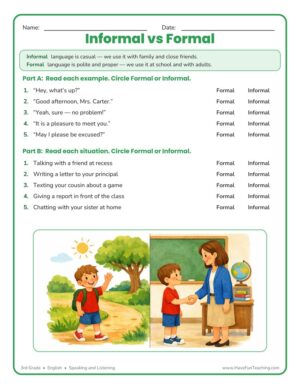
Read two quick lines aloud, like "Hey, what's up?" and "Good morning, Mrs. Lee." Kids hold up an F or an I card. Mix in texts, letters and announcements so they hear how audience changes our words.

Why it works: mixing different kinds of problems in one practice set helped students do far better on a later test (Rohrer and Taylor, 2007).

Informal vs Formal WorksheetTry it withInformal vs Formal WorksheetWorksheetsOpen it →

Questions parents and teachers ask us

What are the speaking and listening skills for 3rd grade?

Third graders take part in group discussions, follow agreed-upon rules, ask and answer questions, and build on others' ideas. They also retell main ideas from read-alouds and media, and speak clearly in complete sentences when they report on a topic.

How do I get shy 3rd graders to speak up?

Start with partner talk before whole-class sharing, and give them a sentence stem to lean on. Assigning roles in small groups helps too, because a "questioner" has a reason to talk. Celebrate the attempt, not just the polished answer.

How can I practice listening skills at home?

Read a short story aloud and ask your child to retell it in three sentences. At dinner, play "repeat and add": each person repeats what the last person said, then adds one idea. It is surprisingly hard and a lot of fun.

What is the difference between formal and informal language?

Formal language is what we use with adults we don't know well, in reports and in letters. Informal language is for friends and family. Third graders learn to pick the right one for their audience.